Showing posts with label 2200m. Show all posts

Tuesday, 26 September 2017

Getting Started On The New LF and MF Bands

Finally the long wait is over! The LF 2200m band and the MF 630m band have finally arrived for amateurs in the USA! I'm sure most of you have read the fine print regarding deployment of the two bands, but if not, here is the ARRL's recent announcement.

It has been a very long wait for the FCC to implement these bands after they were approved for amateur use in 2007 and 2012 at the World Radiocommunication Conferences in Geneva. Canadian amateurs have had 630m since 2014 and 2200m since 2009 ... in the meantime, we have been anxiously awaiting the arrival of American amateurs to liven things up and to garner new interest in these bands.

Before operating on these bands, amateurs in the USA are required to register their intent via a simple web form found here on the Utilities Technology Council's website. Then follows a 30 day waiting period during which the UTC will check out your location to be sure that you are not located within 1km of any power lines that might be carrying LF or MF PLC (Power Line Carrier) control signals. If you hear nothing back from UTC within 30 days, you are good to go.

A positive outcome of registering via the UTC form is that there can be no PLC signals implemented on the lines near you at a later date! By registering your intended operating location(s), you are locking-in these spots for no further PLC development. If you have an EOC or Field Day site that you think you may want to operate from at some point, register these as well.

I think it is important that even if you do not intend to operate on either of these bands or perhaps a few years down the road, that you register as soon as possible ... the fewer PLC signals operating close to or within the amateur radio spectrum, the better, and this is one way of furthering that goal.

There has already been a vast amount of published information on both of these bands, describing transmitters, receiving systems and transmitting antennas so I won't go into much detail here regarding these topics ... and besides, it's always very interesting to search these things out yourself, learning as you go. Be assured that either of these bands will present interesting new challenges not encountered in typical HF operation, but all of the basic principles you are used to still apply ... it's just that things are much bigger down below the broadcast band!

Far and away, the best source of information for US amateurs can be found on John Langridge's (KB5NJD) NJDTechnolgies website. John has been operating on MF for several years already with an experimental licence (WG2XIQ) and is more than an expert on this topic.

His daily blog includes a detailed account of worldwide activity on 630m and makes for fascinating reading. His website provides all of the information and valuable links that you might need to plan your own LF or MF station. The information on his site, if printed out, would make a wonderful LF / MF Handbook!

My own blog and website also contain much helpful material, with a particular emphasis on Canadian activity on these bands. All of my blogspots dealing with 630m can be found here and contain enough bedtime reading to keep you busy for many nights.

If you are thinking of getting on either of these new bands, particularly 630m, here is a short Q & A that may help you through the initial planning stage of  how to get started.

What modes are commonly used on these bands?

At present, due to the low level of two-way amateur radio activity, the WSPR mode has been dominant. This is a weak-signal 'beacon-only' mode so most two-way contacts take place either on CW or on the weak signal JT-9 mode. JT-9 has been specifically designed for HF and LF / MF weak signal two-way work and can dig as deep as -27db into the noise to provide a contact that could never be completed on other conventional modes such as CW.

With the influx of new activity on these bands, particularly on 630m, I expect that most two-way work will equal or surpass the amount of WSPR activity and that JT-9 and CW will do most of the heavy-lifting.

How far can I work on these bands?

Although the erp limits appear to be QRP-sized, this is somewhat misleading ... it is astonishing what can be done. Don't think that '5W eirp' means that you can only run a transmitter capable of generating 5W. Because antennas are so inefficient on these bands, it is often necessary to run several hundreds of watts in order to achieve the legal eirp limits. The bigger and more efficient your antenna, the lower the power needed becomes. On many nights, 5W eirp will get you clear across the country on MF.

However, if you build something for 630m that only produces 25W of power, you will still have the capability of working many stations in other states on most winter evenings or mornings, as propagation, the 'great equalizer', can be amazing at times.

Presently, most stations operating on WSPR will often be detected from one coast to the other and those with excellent locations near the coast will soon be working stations down under or in Europe, either on CW or on JT-9. If you can, design and build for the maximum eirp, 1W on 2200m and 5W on 630m.

What type of transmitter do I need?

If your interests are only in CW, then the sky is the limit when it comes to design. There are numerous simple solid state transmitter designs out there, using inexpensive FETs to generate power. I'm hoping, along with many others, that there will be a considerable amount of CW activity on 630m and even a simple 25-watter should provide you with lots of  fun. There may also be some appetite for QRSS CW which can give the weak-signal digital modes a run for their money while still using a simple transmitter.

If you are interested in digital modes, such as WSPR or JT-9, the easiest way is through the use of a transverter to take care of converting your HF transceiver's capabilities to LF or HF. There are presently a few commercial transverter options available and can be found on the NJDTechnologies links page.

A good choice is the inexpensive 630m transverter produced by John Molnar, shown below and available both as a kit or prebuilt. It works well and is very popular.

630m Transverter - John Molnar WA3ETD / WG2XKA
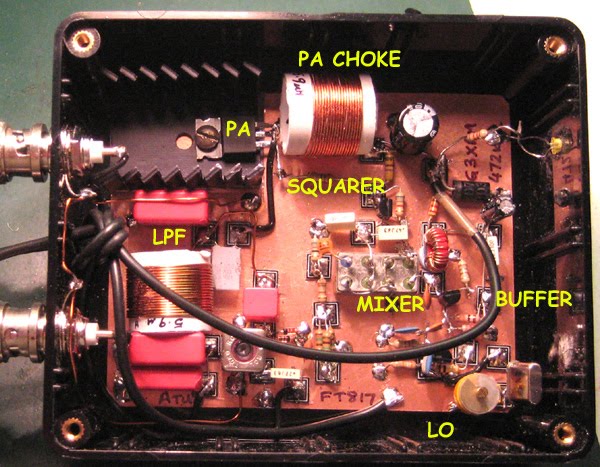
Although not available commercially, another popular 630m homebrew design is one from G3XBM which will also provide a way to get on the digital modes. He also has a 2200m design, should your interests be focused on that band.

G3XBM -630m Transverter
Any of these simple transverters are capable of controlling a higher-powered switching FET amplifier as your station progresses.

If you want something in the 'Collins category', the tranverters (both 2200m and 630m models) produced by VK4YB's Monitor Sensors provide around 70W output and are incredibly well designed and built. I have been very happily employing a 630m model for well over a year now ... my review of the transverter can be found here.

VK4YB - 630m Transverter
I suspect that we may soon see more commercial products become available over the next year but if you are handy with a soldering iron, building your transmitter will all be part of the 630m challenge!

I would like to put on a beacon. What do you suggest?

The best and most informational type of beacon is a WSPR mode beacon. A WSPR beacon operator can always determine where his beacon is being heard, in real time, along with how well it is being heard, by watching the uploaded 'spots' of his beacon on the WSPRnet. You will have much better coverage with this weak-signal mode beacon compared to one on CW ... for every CW report received, you would likely get ten times or more that number on WSPR.

Although WSPR is a great mode for checking out propagation, it's very easy to get into the habit of nightly beaconing and not developing your station any further. If you do run a WSPR beacon, be sure to try some of the other two-way modes such as CW or JT9 and call CQ regularly ... ham radio is all about making two-way contacts!

I don't have enough property for the large antennas required, so I won't be able to use these bands.

Even if you are limited in space, you can still enjoy these bands. There are many examples of stations on small city or suburban-size lots that are consistently heard across North America on 630m. If you have the room for an 80m or 40m dipole or inverted-L, that will be enough space to work these bands. An inverted-L for example, can be base-loaded and tuned to resonance. Along with several ground radials, even a small antenna system like this will allow you to work skywave DX or be heard across the country when propagation is good. I'm constantly amazed at how well these bands propagate with very low amounts of erp. Don't let living on a small lot stop you from exploring these bands!

All I hear is noise on these bands ... how can I use them if I can't hear anything?

Growing noise floors are common to everyone and this is often the biggest challenge for LF and MF operators, especially those in densely populated regions. Armed with a little knowledge and investigation, oftentimes seemingly impossible QRN can be substantially reduced if not eliminated entirely ... even easier when the noise source is found to be in your own home! While some amateurs just give up at this stage, most will see it as an interesting challenge to be overcome and part of the many learning experiences offered by these new bands.

In addition to the informational links provided above, I have just added a new 'Getting Started On 630m' page to my website. This page has a two-part article that I recently wrote for The Canadian Amateur, our national amateur radio journal. The articles describe a simple way of getting on 630m CW as well as providing some basic antenna information and ideas.

This blog also has extensive writings involving 630m over the past few years, describing equipment used and suggestions for new operators, much of it involving homebrewing. There are several links on the right that will take you to specific blogs dealing with 630m.

For present LF and MF operators here in Canada, the arrival of our American friends to these bands is generating much excitement and anticipation. The opening of these bands in the USA will pump new life into this part of the spectrum for all North American participants and the opportunities for homebrewing and experimenting are boundless. It should be a very exciting winter!

If you have not taken the 60 seconds required to register your station on the UTC webpage, please don't neglect to do this via the link provided above. There have, reportedly, been thousands of amateurs doing this already, as it effectively locks-out their locations for any future PLC deployment that might keep them off these bands at a later date.

See you in mid-October on 630!

Friday, 5 May 2017

LF / MF News From Monitor Sensors


A note from Roger, VK4YB of Monitor Sensors, reports some interesting news.


You might recall that his company manufactures a very versatile and well-engineered 630m transverter which was used at both ends of our two 630m JT9 contacts last year during the fall equinox propagation peak between North America and down-under.

Roger now reports that Monitor Sensors will be producing a new 2200m transverter, with all of the bells and whistles found on the 630m unit which has proven to be a real workhorse.


Monitor Sensors 2200m Transverter

The Monitor Sensors TVTR2 2200m Transverter enables any Amateur Radio Station, equipped with a conventional HF transceiver, immediate, all mode, access to the new 135.7-137.8 kHz, 2200m band.
The receiver design incorporates a 7pole Chebyshev filter, 3kHz wide roofing filter and a 5 pole Chebyshev filter in cascade before the double balanced, commutating mixer, fed by an ultra stable, temperature compensated, extremely low phase noise, MEMS local oscillator. The mixer is followed by a Chebychev band pass filter into an ultra linear, low noise, current feedback, IF amplifier. The receiver noise floor, in a 500Hz bandwidth, is -125 dBm and yet the onset of compression is not reached until +11dBm. A front end 20dB attenuator can be switched in for even higher signal handling. Overall receiver gain is set to +6dB, or -14dBm with attenuator in.


The transmitter input circuit incorporates a 0-14 dB switched step attenuator to prevent over driving. The same mixer and local oscillator are used on the transmit side. The PA uses 6 rugged lateral FETs in class AB push-pull to easily achieve the 50 watts rated output. Lateral FETs are inherently linear and thermally stable. The transmitter can be run at full power, indefinitely, into a dead short or open circuit without any danger of damaging the FETs. Transmit-receive switching is automatic with user selectable VOX delay. Alternatively the PTT line may be used.


The transverter employs extensive and accurate metering. Power input and output, SWR, Frequency, Attenuation in use, Temperature, Supply Voltage, Current and Resistance are displayed.
Transmission is inhibited if carrier frequencies outside the 135.7-137.8 kHz band are detected. A tuning screen may be selected which displays SWR in digital and graphical form for easy antenna adjustment. The menu system is self explanatory and users report no manual is needed, although one is supplied. A USB socket is provided for future code upgrades (free of charge) from the Monitor Sensors web site.


The transverter has been designed for the best possible protection against accidental mishaps. It will survive reverse polarity supply and the injection of 100 watts of HF into any of its ports whether in transmit or receive mode. If supply current exceeds 25 Amps, the supply is cut in 3 microseconds. This electronic breaker can be reset by simply switching off and on again. The transmitter will shut down in the unlikely event that the internal heat sink reaches 90°C. The cooling fan is under the proportional control of the microcomputer and begins operation above 35°C. Any unusual operation will cause the screen to turn red and an appropriate warning will be displayed.


TVTR2 Specifications


RF frequency range 135.7 to 137.8 kHz
IF frequency range 1805.7 to 1807.8 kHz (others available in the 160m band)
Transmission modes CW, SSB, WSPR, and all other data modes
Output Power 50 Watts Continuous, 100% duty cycle @13.8V supply
Input and Output Impedance 50 Ohms
Supply voltage 13.8 VDC @ 15 Amps nominal, 10-16 VDC operational
Rx noise floor -125 dBm (500 Hz bandwidth)
Rx 3dB compression point +15 dBm (Rx attenuator out)
Rx IF rejection better than 75dB
Rx conversion gain +6dB nominal
Roofing filter in-band ripple +/- 0.5dB
Tx 3rd order IMD -33 dB below PEP, typical at 50W output
Tx 5th order IMD -45dB below PEP, typical at 50W output
Tx harmonics and spurii All better than -50dB
Tx conversion gain +10dB nominal
Power input connector 2 * Anderson Power Poles (one Power cable supplied)
RF connectors 3 * SO239 (one PL259 to PL259 cable supplied)
PTT connectors 2 * RCA (one RCA to RCA cable supplied)
USB connector Micro B USB, (matching cable supplied)
Dimensions 12½ * 4¼ * 3 inches, 320 * 120 * 76 mm
Weight 3.4 lbs, 1.6 kg


In addition to the transverters, Monitor Sensors will also be manufacturing solid state amplifiers for both the 2200m and 630m bands with power levels at around the 450W output level. Like the transverters, these will be 'linear' devices as well. It is possible that a duo-band amplifier will also eventually be produced.

It will be interesting to see if any other new gear becomes commercially available from other manufacturers once the LF / MF ham bands are introduced in the U.S.A. , something that is expected to happen fairly soon.

Thursday, 27 April 2017

LF / MF Antenna Planning

courtesy: Chuck Roblin

For U.S. amateurs, the 2200 and 630m bands will soon be a reality and I have no doubt that there will be an accompanying surge in interest among large numbers of homebrewers and low band diehards.


It should be an exciting time as new stations gradually start to populate the band from coast to coast.

High on the 'to do' list will be the planning and building (or modifying) of a suitable antenna system for the band(s) of choice. For most, this will be new territory, but the reality is that there has been a long tradition of operation in the LF and MF bands in the U.S. for many years ... all under the Part 15 'Lowfer' and 'Medfer' service.

Although activity in this category has fallen off over the years due to the availability of the much less-restrictive Part 5 experimental licences, there is still a great legacy of literature and information left behind that is every bit as useful today as it was back in the golden years of Lowfer operations.

Here is one such document from Stephen McGreevy's Natural ELF-VLF Radio website that many newcomers to these bands may find very helpful as it covers a wide variety of LF antenna-related basics in a down-to-earth manner.

An even more detailed treatise on virtually all aspects of LF and MF antenna topics is that found on Rik, ON7YD's website. His antenna pages can be found here. Although originally developed for the 2200m band, the principles are equally applicable to 630m as well.

Hopefully both of these sources will help you decide how to get a working antenna system up and running on the new bands. And as always, much help is available via the Internet on the Lowfer Reflector, the RSGB LF reflector or on the 600MRG Reflector.

Thursday, 30 March 2017

LF and MF Now Very Close For U.S. Amateurs!


For U.S. amateurs anxiously awaiting implementation of the new 630m and 2200m bands, the wait seems to be almost over!


Good news came down late yesterday in the form of the FCC's "Report and Order" (ET Docket No. 15-99) which lays out the proposed rules and regulations that, barring any further changes, will likely become standard operating procedures once these two bands become finalized.

Highlights of the FCC's document are as follows:

1. Recognition that both Utilities (UTC) and amateurs can co-exist within these parts of the spectrum:

... co existence between PLC systems and amateur radio operations in these bands is possible, and the service rules we adopt in this Order will foster this co existence.

2. Amateurs operating within these bands must be no closer than 1 km from transmission lines that are actively carrying PLC (control) signals:

As proposed, we will permit amateur stations to operate in the 135.7-137.8 kHz and 472-479 kHz bands when separated by a specified distance from electric power transmission lines with PLC systems that use the same bands.   To support the operations of both the amateur service and PLC systems in these bands, we adopt a minimum horizontal separation distance of one kilometer between the transmission line and the amateur station when operating in these bands.

We find that a one kilometer separation distance reasonably ensures that PLC systems and amateur radio stations are unlikely to experience interference.  In addition, establishing a zone where amateur use is not authorized will simplify and streamline the process for determining whether an amateur station can transmit in these bands when in proximity to transmission lines upon which PLC systems operate.

3. Amateurs must "make notification" to local UTC authorities before commencing operation on either of these two bands:

We will require amateur operators to notify UTC of the location of their proposed station prior to commencing operations, to confirm that the station is not located within the one kilometer separation distance. 

The notification requirement will entail notifying UTC of the operator’s call sign and coordinates of the proposed station’s location for confirmation that the location is outside the one kilometer separation distance, or the relevant PLC system is not transmitting on the requested bands.  UTC, which maintains a database of PLC systems must respond to the notification within 30 days if it objects.  If UTC raises no objection, amateur radio operators may commence operations on the band identified in their notification.  The Wireless Telecommunications Bureau will issue a public notice providing the details for filing notifications with UTC.

A simple notification to UTC with a 30-day waiting period does not appear to be burdensome.  Amateur operations can commence as soon as that period expires.  ARRL claims that UTC should provide access to the PLC database to them or directly to amateurs to assist them in determining whether their notified operations are within the one-kilometer separation distance from transmission lines with PLC systems operating on these bands.  ARRL fails to make a persuasive case why it would be a better organization to make those determinations rather than UTC.  Further, since UTC has control of the PLC database which can be updated, we find no reason to mandate its release to another party especially considering the sensitive nature of information it contains.

4. Power limits will be expressed in EIRP as well as maximum PEP:

Amateur stations may operate in the 135.7-137.8 kHz band with a maximum radiated power of one watt EIRP ... that amateur stations operating in the 135.7-137.8 kHz band should be subject only to the general Part 97 limit of 1.5 kW peak envelope power (PEP).

We also adopt the power limits proposed in the WRC-12 NPRM for amateur stations operating in the 472-479 kHz band.   For such stations, the maximum radiated power will be five watts EIRP, except for stations located in the portion of Alaska that is within 800 kilometers of the Russian Federation, where the EIRP will be limited to one watt.  We also limit the transmitter power for amateur radio operations in the 472 479 kHz band to 500 watts PEP; provided, however, that the resulting radiated power does not exceed five watts EIRP.   In other words, it may be necessary to reduce transmitter power below 500 watts PEP to avoid exceeding the five watts EIRP limit.

5. Antenna height will be limited:

... we will require that the antennas used to transmit in these bands not exceed 60 meters in height above ground level (AGL), as ARRL proposed.

6. Regarding transmission modes, no bandwidths have been specified in order to encourage experimentation:

Consistent with our proposal in the WRC-12 NPRM,  and with the existing rules in Section 97.305 for the frequency bands below 30 MHz, we authorize amateur stations to transmit the following emission types throughout the new amateur bands: CW (international Morse code telegraphy), RTTY (narrow-band direct-printing telegraphy), data, phone, and image emissions.   These emission types provide amateur operators with maximum flexibility, and we find that additional restrictions would needlessly hinder experimentation.

7. Experimental stations appear to 'still be in business' but are encouraged to transition to the 'amateur' service:

Finally, we decline to permit previously licensed experimental stations – some of which have been authorized with significantly more radiated power than the adopted EIRP limits for these new amateur service bands – to communicate with amateur stations operating in these bands.  Amateur operations in these bands currently authorized under experimental licenses should transition their operations in accordance with the adopted rules and not circumvent such rules by use of experimental licenses.

My understanding of the R&O document is that participating parties may still file a 'Petition For Reconsideration' notification within 30 days of the R&O's publication in the Federal Register. Once these (if any) are dealt with, there are no other roadblocks preventing immediate implementation.

The document contains additional details not discussed here and makes fascinating reading for amateurs that might be looking forward to the new allocations.

This is the news that many U.S. amateurs have been waiting many years to hear! It is also good news for Canadian's operating on these bands to know that they may soon see a large increase in activity south of the border. Let's hope things continue to transpire favorably and that we will finally see the new bands become a reality.

Get those soldering irons out guys and gals!

Monday, 2 May 2016

The Joys Of ERP

Amateurs and and U.S. experimental licence holders operating on the LF and MF bands, are limited in the amount of power they are legally able to run. Unlike the HF bands, where maximum power limits are expressed in either DC power input or PEP output, LF and MF operators are required to observe ERP or EIRP limitations. Canadians operating on 2200m are limited to 1W EIRP and to 5W EIRP on 630m.

Although this doesn't sound like much, mustering this amount of effective power can be quite a task on either band, especially on 2200m. This is due to the very poor efficiencies encountered when using antennas that are so small in size compared with what would be considered 'normal'. For example, a typical 1/4 wave vertical used on 40m is about 33' high and with a good radial system can achieve efficiencies in the 80% range, while the equivalent antenna for 2200m would be 550m or about 1800' high ... a little large for most suburban backyards!


The equivalent of a normal 2m 'rubber-ducky' antenna when built for 2200m would be over 600' tall, while one designed for 630m would be around 170' high! A 2" stub used on your 2m hand-held would be the same as a 56' vertical on 630m. Consequently, most LF / MF backyard antennas will realize efficiencies of less than 1% and likely, quite a bit less.

In order to reach the maximum radiated power levels allowed usually requires several hundreds of watts, especially on 2200m, where near kilowatt levels are needed. These small radiated power levels might seem discouraging but they don't account for radio's great equalizer ... propagation. More than anything else, RF loves to radiate, and at times, what can be achieved on these bands with such low effective radiated powers is stunning

It would seem that Industry Canada did us no favors when they stipulated LF / MF power levels to be measured in EIRP and not the, much easier to calculate, DC power input level ... or perhaps they did. I think that, unlike on HF, imposing EIRP rather than DC input power limits puts everyone on an even playing field. Amateurs with lots of real estate and room for a larger, more efficient LF antenna, will be required to run much less power to reach the allowable EIRP and 'stay legal', compared to someone with a small backyard in the suburbs ... the latter can legally generate the higher level of DC input power required to reach the EIRP limits since their smaller antenna is operating at less efficiency. However, determining EIRP is not as cut and dried as measuring input power.

With some fairly sophisticated (ie. expensive) field strength measuring equipment, not typically found in amateur radio operations, ERP / EIRP can be readily determined. This means that for most amateurs,  alternate methods must be used.

Neil, WØYSE in Vancouver, Washington, who runs an experimental 630m station under the call of WG2XSV, has produced an excellent treatise on calculating your station's EIRP level, providing a step-by-step procedure to follow.

In order to determine your ERP / EIRP, you must first determine your antenna's radiation resistance. Two methods of calculating the antenna's radiation resistance for both verticals and top-loaded verticals (inverted L's or T's) are demonstrated, using the physical size of the antenna in relation to the frequency of operation. Once this value is known, the antenna current is measured while transmitting. These two values allow the Total Radiated Power (TRP) to be calculated. The TRP is then multiplied by 3 to yield the EIRP or by 1.82 for ERP. Roughly speaking, 5W EIRP is the equivalent of 3W ERP. Thanks to Neil for this helpful resource.

An alternate method of roughly determining ERP / EIRP values is an interesting new online 'antenna simulator' at the 472kHz.org site. Using known physical sizes along with your ground quality description, the calculator will indicate what total power output is required to produce various levels of ERP and EIRP as well as expected antenna currents, at 472kHz. It's a good starting point if you are either planning a new antenna system or perhaps, repurposing an HF antenna such as an 80m inverted-L or an HF center-fed dipole for use on 630m.

Neil has also sent the following comments that will be of interest to those planning a sloping-wire tophat:

Hi Steve,

I just read ur article about the Joys of ERP and EIRP. I am always glad to see those blogs about the LF and MF bands. They help get people interested in the new bands.

Thanks for mentioning my treatise on Rr, ERP, and EIRP. On that page is a link to an Excel spreadsheet that I developed to make the calculations easy. You can see it here.

However, it assumes that the top wires are horizontal. If the top wires are slanting downward, as when they double as the upper part of guying lines, then we have to modify the data we enter in order to get closer to what a NEC antenna modeling program would tell us.

Here is what I learned recently from Jim, W5EST (in one of his recent articles on the 630m daily report on John Langridge's blog site). If the top hat wires slant downward, then we need to subtract 1/2 of the downward component of the hat from the vertical section of the antenna due to partial cancellation of the radiation of the vertical section. Similarly, since the wires slant, their horizontal reach is less, so we must add up all the horizontal components of the top wires and enter that as the top load data.

Here is an example from my own antenna system: My antenna is 40 feet tall. My three top loading wires drop 18 feet and they extend out from the vertical 17 feet. So my effective height (for this SS) is 40 - 1/2(18) = 31 feet. Then the horizontal number for my top load is 3 times 17 feet = 51 feet. I have attached a copy of the SS for you with this data entered into it.

Some of Jim's articles are being copied onto a developmental site here. Scroll down the left side to TRANSMIT ANTENNAS. There are 7 articles there by him and some others as well. Eventually (soon maybe ?) they will be moved over to "630m.net".

There are also a number of online calculators, such as found here, that will indicate your ERP / EIRP value when you plug in your antenna's 'gain' figure along with your TPO value. Some of the better antenna modelling programs can produce estimates of your antenna 'gain' at 630m and from there it is a simple matter of calculating what power is needed to reach the legal level.

I'm sure there will be a lot more information and discussion about this topic once the LF and MF bands are released in the U.S.A. but in the meantime, calculating your ERP / EIRP levels is not as hard as it might initially seem ... and is likely accurate enough for most agencies overseeing amateur radio activities.

Monday, 4 April 2016

630m To Down Under

Today's Sun courtesy: http://sdo.gsfc.nasa.gov/


With the sun remaining reasonably quiet over the past several days, a sudden spike in the geomagnetic field on Saturday afternoon saw a number of trans-Pacific spots showing up on 630m WSPR mode.

courtesy: http://wdc.kugi.kyoto-u.ac.jp/
In the predawn hours of Sunday morning, my own system decoded the VK3ELV WSPR beacon, located in south east Australia, 12,992 km from here. From an e-mail exchange, it seems that VK3ELV is using a 'drifting' IC706M2G on 10Mhz with a VK3XDK Transverter into an old HF AMP (2x 2SC2290) modified for 630m. This is running about 130-140 watts output. The antenna is an inverted L about 30 metres high and 1/4 wave long.

courtesy: https://www.google.ca/maps

VK3ELV 630m
Further to my south, the WG2XGP WSPR beacon run by Larry, W7IUV in central Washington, was reported down under by two different VK's on Sunday morning as well ... VK4YB and VK2DDI, both some distance from VK3ELV.

courtesy: https://www.google.ca/maps
It's interesting to note the time difference for these receptions, with Larry's reception being several hours earlier than my own (1304Z), close to my sunrise. As well, the 'spotlight' effect of propagation over such a vast distance is somewhat intriguing. I would have thought that if I should see any VK's on 630m, it would be the closer ones and not the further one, yet it was just the opposite.

Although VK3ELV's signal was right at the edge of WSPR decoding levels (-29db), it would only take a few more db to allow a two-way JT9 digital mode QSO to take place ... maybe something that will be possible in the coming years of solar minimum and much better LF/MF propagation. To be readable on CW would need an equivalent true power output increase of at least 16 times, requiring VK3ELV to run around 2,000 watts output!

Over the years I have seen ZL6QH a number of times on 2200m (QRSS CW mode) but this is my first reception of VK and, hopefully, not my last.

To keep up to date with overnight activities on 630m, visit the excellent site of KB5NJD. John posts a detailed daily summary of events. In addition, you will find some excellent resources to help you get involved in this part of the spectrum ... and remember, you don't need a big backyard or a big antenna to have fun on 630m.

Friday, 25 March 2016

ARRL Working For LF / MF Future


As the rollout of new LF and MF ham bands grows closer for U.S. amateurs, earlier this month, the ARRL requested the FCC to carefully consider the procedural requirements governing the advance notification of local electric authorities of their intended 630m / 2200m operation. The FCC had suggested that under certain circumstances (mainly the distance to the nearest PLC signal-carrying power lines), amateurs would be required to notify and co-operate with power authorities ... but it was all very vague and seemed to place the conditions under which operating authority would be granted into the hands of the power companies.

In what appears to be a preemptive move to head-off the (possibly) overly onerous and impossible roadblocks suggested by power company representatives, the ARRL filing states:

“ARRL does not object to such a notification requirement, provided that it is appropriately circumscribed, not overbroad in its applicability, and not overly burdensome for radio amateurs to comply with,” the League’s statement asserted.

In addition, the power authority Utility Telecom Council (UTC) has been notably silent on the issue ... slowing the process even further.

"The ARRL noted that comments filed by the Utilities Telecom Council (UTC) called for a system of “quasi-coordination” by radio amateurs before commencing operation on 2200 meters (135.7-137.8 kHz). In its remarks to the FCC, the ARRL pointed out, however, that the UTC has not volunteered any information with respect to how a notification process might work nor offered any PLC database information to the ARRL or to the amateur community so prospective users of the band could determine if their operation might be problematic."

The League took the opportunity to remind the FCC, once again, that the low ERP levels generated by amateurs operating on the new bands would have a low probability of creating any interference and further pointed out that PLC systems operating between 9 and 490 kHz are not subject to protection from licensed services.

The ARRL also indicated that any sort of blanket notification requirement prior to transmitting on 2200 or 630 meters “would be clear regulatory overkill,” and that utility companies should clearly be required to demonstrate how amateur operations would cause harmful interference to their PLC (unlicenced) operations.

It's good to see the ARRL still being proactive with regards to procuring these new frequency allotments on behalf of U.S. amateurs ... hopefully making implementation sooner rather than later. The entire ex parte filing can be read here as well as the ARRL's own news posting of the procedure here.

In the meantime, I'll make yet another call-to-arms to fellow Canadian amateurs, who already have these two new bands but aren't using them ... new activity from the western provinces would be especially welcome as there are a now a number of well-equipped stations in VE7 who would like to work you.

Sunday, 4 October 2015

Plans At VY1JA

In the midst of this weekend's California QSO Party, I heard VY1JA calling CQ, looking for the Californians. It had been several years since I last heard VY1JA and the last time that we worked was on 137kHz on the 2200m band.

The CQs continued without much luck as the Californians just didn't appear to be hearing (or looking) to the north ... missing one of the rarest multipliers in North American contests.

Now, I had recently read that the VY1 station had been experimenting with remote operation, so that hard core, experienced contesters, could have the opportunity to hand out the rare 'NT' (Northern Territories) multiplier in future contests ... especially in the popular November ARRL Sweepstakes. I assumed that the station was likely being remotely operated.

After listening to a lot of CQ's going unanswered, I swung the beam towards Whitehorse and sent, "ur 599 down in VE7 land" and sent my call. Much to my surprise, it was my dear old friend 'J' himself, operating the station. What followed was a 10-minute catch-up on what he had been doing over the past few years and his plans for the future.

J in Nunavut as VYØJA
Since we had last worked on 2200m (we both had 'experimental licences at the time since 2200m was not yet an allocated ham band), J had retired ... un-retired for several years of contract work in the Arctic ... and ...re-retired once more, this time for good. With the help of some dedicated contesters, along with a 'gofundme' project on Facebook, J has been re-building his fine station from the ground up. Maybe you would also like to help.

Future plans, now well underway, call for multiband V-beams (520' legs) at 70' aligned to the SE and NW  and some high metal on a pair of 100' towers for the HF bands. As well, a new K-3 will drive an Alpha 9500 amplifier on all bands.


A few of the 20 poles, ranging from 70' to 30', that will be used to support V-beam legs and elevated groundplanes for the low bands.

I've saved the best news for last. J told me that he really wants to get going on 630m as well! His signal will be a wonderful addition to the band as he should be workable by most of the western provinces on nights of normal propagation. I am very much looking forward to working J again on the LF bands, recalling how strong his 100W signal could get during several of our early-morning 2200m CW ragchews.

Welcome back J!

Friday, 4 September 2015

LF/MF Moving Closer For U.S. Amateurs


With all commentary periods for the FCC's 'Notice of Proposed Rulemaking' (Docket 15-99) now closed, it appears that one of the last comments to be filed may contain the most powerful arguments in favor of swift implementation.

In its extremely detailed 42-paged submission, the ARRL states, in no uncertain terms, the reasons why access to both the 2200m LF band and the 630m MF band should not be held back and that service rules should be 'finalized'. Indeed the powerful arguments stated in favor of implementation should go a long way in making this happen sooner rather than later.

The FCC's position is that there is little to no evidence to indicate that amateur radio operation on either band would be incompatible with power company PLC systems, going as far as stating that at distances of 1km or more from PLC lines, "there is no chance of interference". Further supporting their claim, the thousands of hours of experimental operation were offered as powerful proof and that the ARRL was “unaware of any reports of interference to PLC systems arising from that operation conducted pursuant to numerous Part 5 experimental licenses…in the large band utilized by PLCs.”

In addition, the ARRL had harsh words regarding the FCC's attempt to legitimize the growing number of fish-net beacons in the 160m band, and pulled no punches regarding their position in this matter.

"There is no indication that these buoys are compatible with other uses in the band, no track record of interference avoidance or resolution, and certainly no indication that the current operators can be relied on for compliance with the Commission’s rules."

"The Commission is urged to avoid enacting rules that it has no effective ability or intention to enforce. That fishing vessels have, with impunity, illegally deployed radio buoys in this band on a widespread basis (whether or not due to misrepresentations of the importers and retailers of these devices or due to a disregard of the Commission’s rules generally) without even nominal enforcement actions by the Commission, provides no basis for assuming that there will be compliance with any deployment limitations (including geographic deployment restrictions) on these buoys going forward. Nor is there any basis for the assumption that there will be any enforcement action taken with respect to continued illegal operation of the buoys if and when interference is caused. Spectrum planning by the Commission in this context has to be based on ex ante determinations of compatibility rather than mere assumptions, especially where the record indicates such a low level of historical compliance."

A summary of the comments can be read here in the ARRL News while all comments filed for the NPRM be found here temporarily, while the FCC site is down for maintenance.

Saturday, 29 August 2015

Sparking-Up On 2200m

I haven't been on 2200m (135.7 - 138.8 KHz) for some time ... my last transmissions on this band were almost three years ago. The recent acquisition of the 630m band has refocused a lot of my attention but Canadian activity has never been very high on the real 'top band'. Hopefully when the U.S. gets the 2200m band soon, activity will increase on both sides of the border.

An e-mail alert from Toby, VE7CNF, on the other side of Georgia Strait, indicated that everything was ready for a two-way test on 2200m and he was looking for his initial contact on the band. Having not been on the band for such a long time, some review of my 'tune-up' procedures were in order as well as the need to burn out the spider webs in my outdoor loading coil.

Since being on 2200m, I had modified my 2200m kilowatt transmitter so that it could also be used on the new 630m band. To change bands from 630m back to 2200m, I needed to swap the frequency-sensitive power divider back to 2200m as well as re-set the DDS frequency.

2200m Power Divider
Setting my DDS to the correct control frequency and keying the driver stage revealed no sign of a signal on 137.779 KHz. This was puzzling and several re-checks turned-up no reason for the problem ... it seemed as if there was no signal from the DDS into the transmitter. I set everything back to 630m, just to confirm that there wasn't a more serious problem but everything worked just fine. It was then that I realized my error.

When modifying the transmitter, three years ago, I had also changed the transmitter's input frequency divider from a 'divide-by-four' to a 'divide-by-two' scheme. My original system on 137KHz started with a DDS frequency in the 5.48MHz range and then was divided by ten before being fed to the transmitter's input where the 548KHz signal was then divided by four. Using a higher DDS frequency allowed for greater frequency resolution at 2200m and allowed for very small frequency adjustments across the band. I would have kept the same system for 630m except that my 'divide-by-ten' chip was not very happy at 18MHz and refused to divide.The newer system now only allows me to move around the band in 4.5Hz steps. It's really not much of a problem as there is presently a minuscule amount of activity in Canada on 2200m, but as previously mentioned, this may change when U.S. amateurs gain access to the band.

Having sorted out my transmitter problems and confirming that all was well, the next task was to check antenna resonance and impedance matching as it would more than likely not be the same as I had left it. A low-power check using the 'scopematch' indicated that both resonance and impedance were not optimized. Tapping down on the loading coil by one-turn took care of resonance while adjusting the impedance tap in my matching transformer to its lowest value (see matching scheme below) resulted in a near perfect match on the scope.


I'm guessing that the resonance change was due to the recent heavy trimming of the 80' Balsam that supports one end of my 'inverted-L' and large three-wire flatop.


The tree's crown had previously been very dense and some of the branches were almost touching the flatop. The close proximity always made me worry about possible flashover at the antenna ends as voltages here would be several kilovolts. Removing much of the wet green tree branches directly beneath the flatop also likely contributed to the slight change in resonance.


Impedance Matching Transformer On TV Flyback Cores
The change in impedance to a lower value may have been due, in part, to the removal of the tree branches as well but more likely it was reflecting the change in my ground system. When I had last been on (in mid-winter), the ground was well saturated and the water table at normal heights. The present conditions are just the opposite as things are drier than they have ever been and the water table has certainly dropped substantially.

The sked with VE7CNF went smoothly and it was nice to see another new Canadian station taking an interest in the band, along with all of its challenges. Toby's 200W signal was a solid 559 here even with his small antenna system yet to be fully optimized. As well, he was bothered by heavy switching-power supply QRM from a nearby neighbour. Unfortunately, such noise sources seem to be increasing in numbers and are making operation on LF, already a big challenge, even more challenging. Toby has taken up the challenge with enthusiasm and has now had contacts on 2200m well as on 630m, adding to the ranks of active VE7's on LF and ... demonstrating yet again that amateurs can enjoy the LF bands with small 'backyard' antenna systems. Don't let living in the city be a reason to avoid our new LF bands.


Wouldn't it be great to see some activity from our neighbours in VE6 or VE5, both easily workable on both bands from the west coast... maybe you're up to the challenge!

Sunday, 5 July 2015

LF / MF - Time To File


The FCC is now officially inviting comment on its proposal to establish two new amateur bands ... the 2200m LF band (135.7kHz - 137.8kHz) and the 630m MF band (472 - 479kHz).

The detailed proposal was published in the Federal Registry on July 2, thus establishing the comment deadline as August 31st and a deadline of September 30th for 'comments on the comments'.

It is proposed that the Amateur Radio service would be 'secondary users' of this slice of the spectrum. Secondary users must not cause interference to the Primary users and also be willing to accept interference from the Primary users as conditions of operating. In reality, the only primary use of these bands in North America is for hydro distribution control (PLC) signals. Over several years of maximum ERP amateur experimental work, both here in Canada as well as in the U.S.A., there has been no documented interference to these signals nor have the well-shielded PLC signals been a problem for amateurs ... it seems that co-existence is readily attainable.

Whether you have operated on these bands or not (but especially if you have), I would urge you to file a comment expressing your opinions on any of the critical concerns (antenna height, power etc.) expressed by the FCC. All of these were listed in a previous three-part blog, starting here.

If you think that you might like to operate or experiment on either of these bands in the future, then just tell them that as well ... the more interest from the amateur radio world shown, the better.

For those of you that might think that this part of the spectrum has little to offer the amateur, I can assure you that such is not the case. Coast-to-coast propagation has been demonstrated on numerous occasions (on both bands). Both bands offer wide opportunities for experimental work dealing with antennas, modes and propagation as well as providing an abundance of homebrewing opportunities for builders.

Comments may be filed, identified by ET Docket No 15-99 (proceeding number), via the FCC Electronic Comment Filing System (ECFS). As well, you can read all of the comments that have been filed here.

U.S. amateurs have been waiting long enough (since 2007) for an opportunity to use these bands ... let's show the FCC that we really want them by filing your comments before August 31st!

Thursday, 4 June 2015

U.S. LF Bands - Rulemaking Ruminations (Part 2)

(...cont'd)

* TWO: We need more technical showings this time, with as many solid
details as possible. I hope the Part 5 licensees are prepared to crunch
numbers, but those of us who only monitored are also able to contribute.
(Much more on this in future correspondence, I expect.) In par. 169. the FCC enquires: "to meet our goal of providing for the coexistence of amateur services and PLC systems in these bands, we seek detailed comment on the technical characteristics of both the PLC systems and the amateur stations.
This information will allow us to set an appropriate separation distance."
The very next sentence, though, I recognize as a somewhat worrisome bit of FCC-speak: "Although the Commission in the WRC-07 NPRM inquired into the technical rules and methods that would assure coexistence, commenters provided little in the way of concrete information." Read that as said with a slightly scolding tone, but with a facial expression that says they're keeping an open mind.

The utilities, IMO, provided no concrete technical information at all. ARRL
cited the 1985 NTIA study on which the 1 W EIRP and 1 km separation idea is based, but the FCC is concerned whether that's still valid. Well, one would hope that any changes made to PLCs over the past 30 years would be toward making the system more robust, not more vulnerable to evildoers, accidents, and natural disasters, but this could prove an area of contention. That may be something the big guys have to fight out; I don't know how much we as individual licensees or observers can contribute. But there ARE other technical matters the FCC needs and wants to know, which we may be able to furnish.

For instance, what sort of PLC signal levels have we actually experienced in the proposed bands? How serious were their impact on licensed activity, and how have PLCs been coped with in actual operation? Also at paragraphs 171, 178, and 178, the FCC is asking for some really fundamental, crucial data.
Namely: What sort of power levels have the Part 5 licensees actually
radiated, and at what actual separations from transmission lines? What
maximum size should an amateur antenna be, and--the biggie, in my view--what is the efficiency of both "typical" and potential amateur antenna systems?
(The Commission would like us to include information from Canadian and
European hams on these issues as well. Details of amateur practice in the
rest of the world could be very helpful in formulating rules here.)

Those operators who have the capability of measuring their true field
strength are in an especially excellent position to help quantify current
practice. Those who can't do that, but are able to measure their ground
losses accurately, can make reasonable calculations to show the maximum
efficiency possible with antennas of various heights. That's likely
preferable to doing it all in NEC modeling, since not all such software is
really good at predicting ground system losses, especially at LF. I'll
gladly offer my own ground system's resistance numbers to anyone who wants to do the math, for instance, as its 32 radials of 104 to 135 ft length in 15 mS/m soil are probably representative of a fairly decent ground for
antennas up to 100 feet high...and I'll be doing another set of readings
very soon, which can include measurements at 2200 m this year in addition to the runs I routinely do at 1750 m.

* THREE: At 172, the FCC observes: "If we were to adopt our proposal to
permit amateur operations only when separated by a specified distance from transmission lines, when a new transmission line is built close by an
amateur station, the station either would have to relocate farther away from the transmission line or cease operating." Scary, huh. But they go on to ask: "How should our rules address the potential for new transmission lines to be constructed closer than the specified distance to pre-existing amateur stations? We do not want to inhibit the ability of either PLC systems or amateur services to grow and expand without imposing unnecessary burdens on either. Is it possible for utilities to refrain from geographically expanding their PLC operations within the relatively small portion of the 9-490 kHz band that we are making available for amateur operations, and is this something utilities would do on their own accord, given the Part 15 status of PLC systems? Should our rules explicitly prohibit utilities from deploying new PLC systems in these bands?"

My answer: yes, please. Look back at par. 26, in the WRC-07 R&O section
where the Commission explains their basis for adding the 2200 m allocation:
"We intend to structure these service rules to promote shared use of the
band among amateurs and PLC systems. Amateurs will not be able to use their allocation status to force unlicensed PLC operations out of the band, and utilities will have no cause to abandon or incur large costs to modify
existing PLC systems." Read that again: "Amateurs will not be able to use
their allocation status to force unlicensed PLC operations out of the band."
That's the reality of the matter, and yet I think it also works in our
favor.

So far as I know, this situation is unique in the history of radio regulation. I can't think of another example where an incumbent, but unlicensed and unallocated, user of radio spectrum has been afforded such protection from any allocated and licensed service. However, most of us who commented in the 2013 proceeding DID AGREE with the Commission that PLC technology has been a special case for a long time, and most recognized that acceptance of its existence was the only way to move the discussion off dead center and get to the point where we are now.

But I maintain this coin has two sides. If we in a licensed, allocated service are willing to accept that we cannot displace existing PLCs now or in the future, then it is ONLY FAIR that the unlicensed, unallocated users should not be able to displace the licensed users, either, now or in the future. Otherwise, it is not truly sharing.

The only way I can see to guarantee protection to licensed users, comparable to what the unlicensed ones will have, is to incorporate within Part 15 a prohibition on any changes in power, transmission mode, and route of existing PLC systems, or installation of new ones, within a reasonable band centered on the new amateur allocations. That achieves the stated goal of not displacing existing systems or burdening the utlities by forcing any changes to them, while only removing two small slices of spectrum from consideration for future installations. That seems an entirely reasonable compromise to me.

Your comments are welcome--and essential!

73
John Davis


You can view comments as well as file your own, via the link from this page:

http://apps.fcc.gov/ecfs/proceeding/view?name=15-99