Showing posts with label WSPR. Show all posts

Tuesday, 17 October 2017

LF Tests From WH2NXD / NI7J


For those of you with an interest in amateur LF work, you may be interested in the upcoming WSPR test  transmissions from Ron, WH2XND / NI7J, located in Phoenix, Arizona.


One of Ron's several experimental licences allows him to run as much as 10W ERP from 68-76 KHz. To generate this amount of ERP at 75 KHz requires a lot of power and I suspect that he will still be well under his licence limitations ... amateur-sized antennas are just not very efficient on these low fequencies.

Previous experiments a few years ago, at lower ERP, produced impressive results, as shown by one of the WSPRnet maps for an overnight session on 75.075 KHz.


Ron used one of the Hans Summers U3S transmitters to generate his LF WSPR signal, amplifying it with a 400W Hafler audio amplifier. This winter's tests will be at 800W, with a W1VD FET amplifier designed for VLF.

Ron's experimental licence also covers 470 - 495 KHz at a whopping 100W ERP and 130 - 140 KHz at 50W ERP ... some serious power.

You may also find Ron's interesting and well-illustrated website description of some experimental antenna work that he has been doing on MF, LF and what it takes to resonate a typical Marconi 'T' on these bands.

MF- LF 'T' Antenna At WH2XND


75 KHz Loading Coils!

Ron has tentatively chosen late November or early December for his 'almost' VLF tests and when the date and frequency are finalized, I will post the information here on the blog.

Tuesday, 26 September 2017

Getting Started On The New LF and MF Bands

Finally the long wait is over! The LF 2200m band and the MF 630m band have finally arrived for amateurs in the USA! I'm sure most of you have read the fine print regarding deployment of the two bands, but if not, here is the ARRL's recent announcement.

It has been a very long wait for the FCC to implement these bands after they were approved for amateur use in 2007 and 2012 at the World Radiocommunication Conferences in Geneva. Canadian amateurs have had 630m since 2014 and 2200m since 2009 ... in the meantime, we have been anxiously awaiting the arrival of American amateurs to liven things up and to garner new interest in these bands.

Before operating on these bands, amateurs in the USA are required to register their intent via a simple web form found here on the Utilities Technology Council's website. Then follows a 30 day waiting period during which the UTC will check out your location to be sure that you are not located within 1km of any power lines that might be carrying LF or MF PLC (Power Line Carrier) control signals. If you hear nothing back from UTC within 30 days, you are good to go.

A positive outcome of registering via the UTC form is that there can be no PLC signals implemented on the lines near you at a later date! By registering your intended operating location(s), you are locking-in these spots for no further PLC development. If you have an EOC or Field Day site that you think you may want to operate from at some point, register these as well.

I think it is important that even if you do not intend to operate on either of these bands or perhaps a few years down the road, that you register as soon as possible ... the fewer PLC signals operating close to or within the amateur radio spectrum, the better, and this is one way of furthering that goal.

There has already been a vast amount of published information on both of these bands, describing transmitters, receiving systems and transmitting antennas so I won't go into much detail here regarding these topics ... and besides, it's always very interesting to search these things out yourself, learning as you go. Be assured that either of these bands will present interesting new challenges not encountered in typical HF operation, but all of the basic principles you are used to still apply ... it's just that things are much bigger down below the broadcast band!

Far and away, the best source of information for US amateurs can be found on John Langridge's (KB5NJD) NJDTechnolgies website. John has been operating on MF for several years already with an experimental licence (WG2XIQ) and is more than an expert on this topic.

His daily blog includes a detailed account of worldwide activity on 630m and makes for fascinating reading. His website provides all of the information and valuable links that you might need to plan your own LF or MF station. The information on his site, if printed out, would make a wonderful LF / MF Handbook!

My own blog and website also contain much helpful material, with a particular emphasis on Canadian activity on these bands. All of my blogspots dealing with 630m can be found here and contain enough bedtime reading to keep you busy for many nights.

If you are thinking of getting on either of these new bands, particularly 630m, here is a short Q & A that may help you through the initial planning stage of  how to get started.

What modes are commonly used on these bands?

At present, due to the low level of two-way amateur radio activity, the WSPR mode has been dominant. This is a weak-signal 'beacon-only' mode so most two-way contacts take place either on CW or on the weak signal JT-9 mode. JT-9 has been specifically designed for HF and LF / MF weak signal two-way work and can dig as deep as -27db into the noise to provide a contact that could never be completed on other conventional modes such as CW.

With the influx of new activity on these bands, particularly on 630m, I expect that most two-way work will equal or surpass the amount of WSPR activity and that JT-9 and CW will do most of the heavy-lifting.

How far can I work on these bands?

Although the erp limits appear to be QRP-sized, this is somewhat misleading ... it is astonishing what can be done. Don't think that '5W eirp' means that you can only run a transmitter capable of generating 5W. Because antennas are so inefficient on these bands, it is often necessary to run several hundreds of watts in order to achieve the legal eirp limits. The bigger and more efficient your antenna, the lower the power needed becomes. On many nights, 5W eirp will get you clear across the country on MF.

However, if you build something for 630m that only produces 25W of power, you will still have the capability of working many stations in other states on most winter evenings or mornings, as propagation, the 'great equalizer', can be amazing at times.

Presently, most stations operating on WSPR will often be detected from one coast to the other and those with excellent locations near the coast will soon be working stations down under or in Europe, either on CW or on JT-9. If you can, design and build for the maximum eirp, 1W on 2200m and 5W on 630m.

What type of transmitter do I need?

If your interests are only in CW, then the sky is the limit when it comes to design. There are numerous simple solid state transmitter designs out there, using inexpensive FETs to generate power. I'm hoping, along with many others, that there will be a considerable amount of CW activity on 630m and even a simple 25-watter should provide you with lots of  fun. There may also be some appetite for QRSS CW which can give the weak-signal digital modes a run for their money while still using a simple transmitter.

If you are interested in digital modes, such as WSPR or JT-9, the easiest way is through the use of a transverter to take care of converting your HF transceiver's capabilities to LF or HF. There are presently a few commercial transverter options available and can be found on the NJDTechnologies links page.

A good choice is the inexpensive 630m transverter produced by John Molnar, shown below and available both as a kit or prebuilt. It works well and is very popular.

630m Transverter - John Molnar WA3ETD / WG2XKA
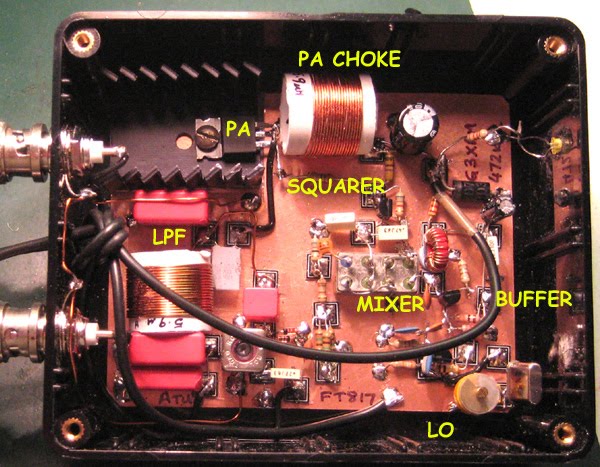
Although not available commercially, another popular 630m homebrew design is one from G3XBM which will also provide a way to get on the digital modes. He also has a 2200m design, should your interests be focused on that band.

G3XBM -630m Transverter
Any of these simple transverters are capable of controlling a higher-powered switching FET amplifier as your station progresses.

If you want something in the 'Collins category', the tranverters (both 2200m and 630m models) produced by VK4YB's Monitor Sensors provide around 70W output and are incredibly well designed and built. I have been very happily employing a 630m model for well over a year now ... my review of the transverter can be found here.

VK4YB - 630m Transverter
I suspect that we may soon see more commercial products become available over the next year but if you are handy with a soldering iron, building your transmitter will all be part of the 630m challenge!

I would like to put on a beacon. What do you suggest?

The best and most informational type of beacon is a WSPR mode beacon. A WSPR beacon operator can always determine where his beacon is being heard, in real time, along with how well it is being heard, by watching the uploaded 'spots' of his beacon on the WSPRnet. You will have much better coverage with this weak-signal mode beacon compared to one on CW ... for every CW report received, you would likely get ten times or more that number on WSPR.

Although WSPR is a great mode for checking out propagation, it's very easy to get into the habit of nightly beaconing and not developing your station any further. If you do run a WSPR beacon, be sure to try some of the other two-way modes such as CW or JT9 and call CQ regularly ... ham radio is all about making two-way contacts!

I don't have enough property for the large antennas required, so I won't be able to use these bands.

Even if you are limited in space, you can still enjoy these bands. There are many examples of stations on small city or suburban-size lots that are consistently heard across North America on 630m. If you have the room for an 80m or 40m dipole or inverted-L, that will be enough space to work these bands. An inverted-L for example, can be base-loaded and tuned to resonance. Along with several ground radials, even a small antenna system like this will allow you to work skywave DX or be heard across the country when propagation is good. I'm constantly amazed at how well these bands propagate with very low amounts of erp. Don't let living on a small lot stop you from exploring these bands!

All I hear is noise on these bands ... how can I use them if I can't hear anything?

Growing noise floors are common to everyone and this is often the biggest challenge for LF and MF operators, especially those in densely populated regions. Armed with a little knowledge and investigation, oftentimes seemingly impossible QRN can be substantially reduced if not eliminated entirely ... even easier when the noise source is found to be in your own home! While some amateurs just give up at this stage, most will see it as an interesting challenge to be overcome and part of the many learning experiences offered by these new bands.

In addition to the informational links provided above, I have just added a new 'Getting Started On 630m' page to my website. This page has a two-part article that I recently wrote for The Canadian Amateur, our national amateur radio journal. The articles describe a simple way of getting on 630m CW as well as providing some basic antenna information and ideas.

This blog also has extensive writings involving 630m over the past few years, describing equipment used and suggestions for new operators, much of it involving homebrewing. There are several links on the right that will take you to specific blogs dealing with 630m.

For present LF and MF operators here in Canada, the arrival of our American friends to these bands is generating much excitement and anticipation. The opening of these bands in the USA will pump new life into this part of the spectrum for all North American participants and the opportunities for homebrewing and experimenting are boundless. It should be a very exciting winter!

If you have not taken the 60 seconds required to register your station on the UTC webpage, please don't neglect to do this via the link provided above. There have, reportedly, been thousands of amateurs doing this already, as it effectively locks-out their locations for any future PLC deployment that might keep them off these bands at a later date.

See you in mid-October on 630!

Monday, 4 September 2017

VE7CNF / 630m Mobile ... almost.

fffffffffffffffffffffffffffffffffffffffffffffffffffffffffffffffffffffffffffffffffffffffffffffffff
If you think 160m mobile is a challenge...


Hot on the heels of his recent 630m maritime adventure, Toby (VE7CNF), continued to demonstrate the flexibility of his small 20W 630m portable system with an afternoon of fixed 'mobile' activity from his vehicle.


Local 630m op's in-boxes received a surprise alert on Tuesday:

"Are any of you available on Tuedsay for a 630m land mobile test with VE7CNF/7?"

Toby set things up at Sea Island's Iona Regional Park, situated on the ocean's edge just north of Vancouver International Airport. This gave him a good shot to several of the local 630m ops around the local region.

When Canadian amateurs first approached RAC and Industry Canada for a slice of spectrum near 500KHz, the main goal was to secure a frequency range that would support excellent groundwave propagation for a possible future emergency data network. Whether this will ever happen or not remains to be seen, but Toby's afternoon outing, along with the recent 630 marine mobile activity certainly helps to demonstrate the potential for the band to provide reliable signals with relatively small antennas and low erp.

Toby's basic transverter is rather unique in that the transmitter's FET power mixer also passes signals backwards to function in the receive mode:

"I’ve developed a 630m band linear transverter that produces 30W of transmitter power. It has no power amplifier and draws only 175 mA from a 12V power supply. It works for both transmit and receive with no T/R antenna relays or switching circuits.

I’ve used a bidirectional high-power mixer circuit to directly take 100W of power from a 160m band transceiver and produce useful output power on 630m. For receive, 630m signals can pass backwards through the circuit and are up-converted to 160m. 

My transverter is actually the small box on the dash above the steering wheel. The gear in the back near the variometer is used only during setup to resonate the antenna. It's a signal generator and oscilloscope. The AC transformers are just an isolation transformer that I need to make the test equipment work with my 12V-to-AC inverter."

Toby VE7CNF/7 at Iona
Toby's own report on the outing:

"VE7CNF/7 Operation was from the Iona Beach area near Vancouver, grid CN89jf. The location is right beside salt water. There are no nearby power lines so rx noise was S0. Operation was in daylight, around 4 pm local time. Signals were excellent and all CW was easy copy. 

On 475.0 kHz CW I managed to work Roger VE7VV (CN88il, him 529, me 579) and Jack VA7JX (CN79kv, him 569, me 579). I heard Steve VE7SL (CN88iu) at 599 briefly, then he had a problem and we didn't complete a QSO. He gave me 599 later by email.

The antenna is about 24 ft high and the fishing-rod-and-wire top load is pulled forward about 8 ft. The matching circuit is a loading coil, variometer, and autotransformer. My Tx power was 20W TPO and estimated EIRP 75 mW. The rig was my home brew transverter with an IC-7410."


"After CW I ran WSPR for a while, 23:42 to 00:08 UTC (4:42 to 5:08 pm local). WSPRnet lists my spots as my home QTH CN89ng, but I did have CN89jf entered in WSJT-X. I got spots from WI2XJQ -17, VE7BDQ +14, VE7AB +6, VE7VV +1, W7IUV -26, WH2XGP -30 dB. I also decoded WSPR from VE7VV +7 and VA7JX +9 dB."

"This was great fun. I'll have to try more locations, and see if I can improve the equipment for easier setup. I had great copy on Roger 529 and Jack 569. Working Jack was a surprise, and his signal was excellent. Being beside salt water is magic. Rx noise was so low at that location, near Iona Beach CN89jf."


Our 'new' band continues to demonstrate its ability to offer exciting opportunities to experimenters, home-brewers and DXers alike and for those with the creative imagination to push new boundaries, who knows where one of the first frequency ranges to be used by amateurs back in the 20's might eventually take us.

I can visualize, at some point in the future, the usefulness of a province-wide 630m emergency comms network utilizing a basic 'grab and go' system based on much of Toby's demonstrated work.

If you are a Canadian amateur why not join the fun on 630m now? U.S. amateurs will be arriving shortly and when they do, things should be getting even more exciting on the new band!

Saturday, 3 June 2017

Digital Revolution Or Evolution?

courtesy: KD0WTE


A recent reflector posting tended to confirm a rather intriguing trend that I have also been noticing over the past few years.


The poster lamented the fact that he often found very few or even no CW / SSB signals on the HF bands while at the same time seeing lots of activity throughout the digital portion of the bands.

It does seem like there is far less CW and phone activity on the HF bands now, than there was a few years ago and there is no question that digital activity has soared. Whether it's RTTY, PSK31, JT65, WSPR, JT9 or others, these digital signals are always prominent and, band plan or not, are slowly migrating further in the band as activity increases ... but is this the reason for the decline of traditional modes?

The digital weak-signal modes make these extremely popular for a number of reasons. Nowadays, many amateurs are living in antenna-restricted communities and are forced to develop smaller, lower and less effective stealthy antenna systems if they wish to get on the air and make contacts. Most of these modes perform well with minimal amounts of power and are capable of hearing well into the noise ... and unless you live out in the country, with well-separated neighbours, we all know that noise is increasing at horrific levels almost everywhere. These two factors alone might well explain much of the growth in digital activity.

Licencing requirements have also been slowly evolving and today, getting a ticket is much easier than it was several decades ago ... and in many cases, without the requirements of knowing anything about CW. Every month, North Americans see a large number of new amateurs, many with no code skills and possibly not much interest in acquiring them. From my own local observations, most of these new amateurs usually head straight to FM on the VHF/UHF bands and have little knowledge of or interest in HF radio. These factors must also play into the demise of activity on the traditional HF modes as well.

We also shouldn't overlook the influence that Old Sol is having on our HF bands as well. Solar Cycle 24 (begun in 2008) has been one of the poorest on record and continues to generate month after month of terribly poor HF propagation. As a young SWL who listened in Cycle 19, (the largest on record), I can vouch for the relationship between HF activity and good propagation. Those were amazing days, when 20 and 15m would stay open all night long ... even 10m would often still be open with F2 propagation at midnight towards VK and ZL! Everyday, month after month, the bands were simply bulging with activity, from end to end ... high solar flux numbers bring high activity numbers and we are now experiencing the downside effects of what happens when the sun dreadfully underperforms. The only exception to band-bulging activity today seems to be limited to major contest weekends only. Where these people go the rest of the time is a mystery.

There are surely other reasons as well for the gradual decline of traditional-mode HF activity, including the fact that the general ham population is getting older. Large numbers of stations are simply 'going away' as interest or opportunity declines and as more of the aging traditional-mode ops go 'SK'. I know of several hams that have just given-up because of insurmountable increases in their local noise floors. Our new and usually younger hams, have largely grown up in the 'digital age' and for those that do find themselves exploring the HF bands without CW skills, might logically settle into the digital modes first.

Things are changing quickly, of that there is no doubt. Last summer, on 50MHz, I noticed a large increase in the number of dedicated CW operators moving to JT65 and JT9 during openings and this summer has already seen another huge migration from one mode to the other.

Although this year's Sporadic-E season is just getting started, I have already heard many more countries on JT65 than I have on the traditional modes (Japan, Philippines, China, Formosa, Alaska, Venezuela, Cuba, Brazil). Yesterday I listened to a PY calling CQ on CW for some length, with no takers, while it seemed most of the usual west coast ops were watching the digital band. I fear that many good QSO possibilities will be lost as more stations switch to the much slower digital modes ... on 6m, many of the openings last for a very short time making CW or SSB the quickest way to complete a contact. The other problem I notice this summer is that there are several JT sub-modes and it is often difficult or impossible to figure out which mode is being used let alone having the time to switch to the other mode before signals are gone ... perhaps a case of having too much of a 'good thing'? Hopefully one mode will emerge as the '6m standard' so all are on the same page.

What will be the long-term outcome of these changes remains to be seen but I suspect we'll see more and more of our HF CW and SSB spectrum space gradually shrinking to make room for more digital activity, likely to become the dominant modes eventually.

As a life-time, almost exclusive CW operator since age 15, I find this somewhat disheartening but must admit that over the past few years, I have found my own level of weak-signal digital activity increasing by leaps and bounds. These are powerful, capable modes and offer amateurs new and exciting challenges from VLF to nanowaves. Are they as exciting as my much-loved CW? Ask me in a couple of years!

Monday, 5 December 2016

ARRL 160 / 630m DX

courtesy: http://www.arrl.org/

This weekend's ARRL 160m CW was a ton of fun.

Conditions were unusually good, which always makes things more interesting.


I ended up with 412 contacts in 78 out of 83 ARRL sections. If I was attempting a WAS on Topband, I would have made it to 48, missing just Nebraska and Rhode Island. Oddly enough, RI was my 50th state when I completed my original 160m WAS, back in 1984, which was certificate #225.

That was done from my tiny 33' wide suburban lot, using the same antenna that I have now, a half-sloper. My radials were strung around all four edges of the property line and just lay on the ground or were stapled to the fenceposts. The power came from a pair of 6146's and was just a little less than I used in the contest this weekend as I entered in the Low Power (150W) category ... however, back then it took me several winters to finish my Topband WAS as there was a lot less activity than there is nowadays it seems. The only other sections missed during the contest were Puerto Rico, Newfoundland and North New York.

With a fairly dormant Sun and the 'almost-quiet' geomagnetic conditions of late, good propagation continued into the week ... in fact, Sunday night was the best I have ever observed on 630m!

Such stable conditions here on the west coast always favor the east-west and polar paths and Sunday proved that in spades. Overall, 53 different stations reported reception of my 630m signal, more than any previous overnight period.

The highlight however, was the reception of my signal in Europe, with five decodes from LA2XPA on Kalvoya  Island off the southwest coast of Norway. Rolf has an exceptional location and nice beverage antennas so most of the heavy-lifting was being done on his end. However, without the co-operation of the propagation gods, none of this would be possible. To make things even better, John, VE7BDQ, also made it across to Norway as his small station continues to perform amazingly well. As I mentioned in an e-mail earlier today, his is the textbook example of what can be done on 630m with a small suburban backyard, some homebrewing skills and a small antenna system.

courtesy: http://wsprnet.org/drupal/wsprnet/map

The WSPRnet map shown here illustrates just how many folks are tuning in every night to this part of the spectrum ... with many getting instantly hooked. Hopefully this great propagation is just a small taste of what lies ahead for us over the next several years of low solar activity.

Friday, 11 November 2016

Saturday's 630m Crossband Night - Reminder


This is a reminder of tomorrow's '630m activity night'. Highlights of the evening will see six different Canadian stations seeking contacts with other amateurs in North America via the 'crossband mode' as they call CQ on 630m CW but listen for replies on their announced (QSX) HF frequency. As well, there will be an increased level of on-air activity from many of the U.S. experimental stations, as they beacon or work each other on various modes including CW and JT9, the WSPR QSO-mode. The experimental stations are also seeking your reception reports.

More information may be found here regarding the activity night, including a detailed list of participating Canadians along with their respective transmitting and QSX HF listening frequencies.

As is often the case, old 'Sol is threatening to throw some junk our way over the next day or two, right on time for our event but please don't let that stop you from participating as often this can actually enhance propagation, especially on the north-south path.

We hope to see many of you tomorrow night!

Thursday, 13 October 2016

630m VK's Light-Up North America


It seems that all of my blogspots of late have focused on 630m propagation ... but what has been happening down there recently has been both amazing and somewhat unexpected. With the growing number of active stations listening and transmitting, the band's propagation capabilities and mysteries are quickly revealing themselves.

Last night was a great example but perhaps the WSPRnet prop map illustrates this best.

courtesy: http://wsprnet.org/drupal/wsprnet/map
The amount of North American activity grows each day, especially now that the DX season has arrived. At one point last night, KB5NJD reports over 100 stations either transmitting or reporting via the WSPRnet activity page! With thunderstorm activity gradually shrinking, reception should only get better over the next few months.

Particularly striking was the long haul propagation from VK to North America, with northernmost VK4YB leading the pack. His 90 watt signal made it all the way to VE3IQB, near Ottawa as well as to NO3M, in Pennsylvania! To provide further hope to those that have little room for big receiving antennas, VE3IQB uses a typical small active e-probe antenna, 20' above ground!

courtesy: http://wsprnet.org/drupal/wsprnet/map
This spotlight propagation to the select regions of the east coast is further mystified by the level of geomagnetic activity overnight, with the K index reaching level 5 and higher!

courtesy: http://www.swpc.noaa.gov/
Interestingly, all of this was right over my head, with not a single peep heard here from Roger. Stations across Georgia Strait, VE7BDQ, VE7CNF and VA7MM all reported hearing Roger as well as being heard by him. For the latter two, yesterday and today represent their initial decodes to down under.

I'm theorizing that Roger's signal was arriving today at much lower angles than normal, evidenced by its far-reaching east coast reception and the fact that it couldn't get over my 600' local obstruction to the west. I've always believed that it takes higher angled signal arrival for me to hear Roger and today's events seem to support this.

Exactly what would cause this to be the case, I'll leave to the experts but I imagine that the sudden surge in geomagnetic activity played a significant role in today's very different propagation paths.

Roger was not the only VK lighting-up the map today. A much more detailed account of all the action can be found on the KB5NJD's daily 630m report here ... all very inspirational and hopefully enough to spur even more new activity on the MF band.

Why not give a listen and see what you can hear?

Tuesday, 11 October 2016

VE3 - VE7 630m QSO


The 630m band continues to provide interesting challenges for Canadian amateurs ... be they antenna, equipment or propagation related.


Sunday night produced another flurry of excitement on the new band, further demonstrating its potential for small stations operating from the suburbs.

On Sunday evening, VE3CIQ in Carleton Place, Ontario (southwest of Ottawa), and I, completed a two-way JT9 contact, following a short exchange of the required information (and more) just after midnight, Ontario time.

courtesy: https://www.google.ca/maps/

Noting the increased east-west favorability over the past few nights, Phil and I decided to give it a shot and were delighted to cover the 2200 mile / 3500km path while Murphy was sleeping and not messing with propagation.

Rather than randomly beacon on JT9, we both set 'calling each other' messages. Although this continued for some time, the QSO only took 12 minutes to complete once I started to decode Phil's signal out west. He had been decoding me and sending signal reports for a long time before his signal eventually peaked up here for the evening. I suspect that we could have continued the contact for the remainder of the night as his signal was getting stronger and stronger as we worked.

Screen shot of QSO from VE3CIQ's end
Following our QSO, Phil sent me some information about his station. His transmitter consists of a Yaesu FT-817 driving an XKA transverter which in turn drives his homebuilt class-E amplifier. The amp consists of three switching FETs in parallel, operating at 24V and produces about 175W out.

VE3CIQ - 630m Station

VE3CIQ - Homebrew 630m Class-E Transmitter
Phil's antenna is an 'inverted-L' style ... 45' up to the top of a Pine tree and then a very very long sloping top hat wire, folded back on itself three times, in a zig-zag pattern. This use of linear-loading allows him to squeeze a near full 1/4 wave antenna into his suburban lot as well as to reduce the size of his loading coil inductance. His ground system consists of ~3,000' of buried radials. By all accounts, it seems to perform very well as his WSPR beacon was recently heard in Hawaii!

VE3CIQ - 630m Linear-loaded Antenna


Phil's station stands as yet another fine example of those living in the suburbs without a lot of room for antennas yet still able to successfully operate and explore our new 630m band. With a little ham-radio creativity, it's surprising how well a small station can perform, especially when the propagation co-operates.


Following our contact, I moved back to the WSPR section of the band and continued beaconing overnight.


Apparently Phil and I picked a good evening to run a sked as the overnight WSPR map shows it to have been the best night of the new DX season so far, with forty-four individual stations reporting my signal via the WSPRnet website.

courtesy: http://wsprnet.org/drupal/
Interest and activity on 630m continues to grow nightly, now that the DX season has arrived and the reality of a 630m ham band for U.S. amateurs grows ever closer.

Wednesday, 28 September 2016

630m And Recent Geomagnetic Activity


High levels of geomagnetic activity have usually, but not always, been the kiss-off-death for LF/MF propagation.

These past few months have seen fairly regular field disturbances, often pushing the K index to a level '5' or higher. However, while usually attenuating the east-west and northerly polar paths, the Trans-Pacific path often seems to benefit from these events ... particularly last night.


Perhaps it is related to the equinox's normal preference for this path or maybe the goop the sun is sending us at this point in the cycle is different or not as energetic as it is at mid-cycle. Nevertheless it's really encouraging to see that not all disturbances are detrimental to LF propagation.

For a daily summary of all overnight activity and much more, see KB5NJD's '630m Daily Reports'.

The WSPRnet map reproduced below shows the extent of reception during my own overnight WSPR 630m beaconing session. Missing are many of the normal spots from the eastern provinces and east coast states, indicating the attenuation on this path. Everything else seems enhanced.

courtesy: WSPRnet

The path to down under, in-spite of my obstruction in that direction, perked-up as well, with VK4YB decoded here 19 times as well as VK3ELV's 150W and inverted-L near Wangaratta, Victoria.


               13:56      VK4YB      0.4756      -28   QG62ku   11820      
               13:50      VK4YB      0.4756      -28   QG62ku   11820      
               13:44      VK4YB      0.4756      -24   QG62ku   11820      
               13:40      VK4YB      0.4756      -24   QG62ku   11820    
               13:30      VK4YB      0.4756      -27   QG62ku   11820      
               13:24      VK4YB      0.4756      -20   QG62ku   11820      
               13:18      VK4YB      0.4756      -24   QG62ku   11820    
               13:12      VK4YB      0.4756      -22   QG62ku   11820    
               12:42      VK4YB      0.4756      -26   QG62ku   11820    
               12:14      VK4YB      0.4756      -20   QG62ku   11820    
               12:02      VK4YB      0.4756      -23   QG62ku   11820    
               11:58      VK4YB      0.4756      -25   QG62ku   11820    
               11:52      VK4YB      0.4756      -25   QG62ku   11820    
               11:40      VK4YB      0.4756      -29   QG62ku   11820      
               11:32      VK4YB      0.4756      -26   QG62ku   11820    
               11:24      VK4YB      0.4756      -25   QG62ku   11820    
               11:12      VK4YB      0.4756      -22   QG62ku   11820    
               10:56      VK4YB      0.4756      -26   QG62ku   11820    
               10:54      VK4YB      0.4756      -25   QG62ku   11820


Merv, WH2XCR in Hawaii, was spotted here 56 times, with numerous transmissions at 'easy CW' levels. He even spotted me twice, with his 80m dipole, presently laying on the ground!

It was also encouraging to see 21 spots from Eden, ZF1EJ in the Cayman Islands, with several at CW levels.

The following stations all uploaded spots of my overnight WSPR signals, as nightly activity continues to grow with the DX season now at the doorstep. Given equal ERP, most of these stations would be workable on either CW or on JT9.

              WH2XGP      DN07dg      319      122
               WG2XSV      CN85sr      353      169
               WI2XJQ        CN87ts      138      150
               NO1D         DM34tn      1825      147
               N3IZN/RX  DM13ji      1796      161
               WW6D      CM88pl      1155      177
               VE7CNF      CN89ng      55      33
               VA7MM      CN89og      59      38
               WE2XPQ      BP51ip      2151      321
               W5EMC      EM10cl      2963      124
               K5ACL      EM10bd      2987      125
               WG2XXM    EM15lj      2610      115
               ZF1EJ/1       EK99ig      4977      116
               KE7LGT      DN26xm      739      107
               W3PM       EM64or      3365      104
               ZF1EJ        EK99ig      4977      116
               VE7KPB      DN29cm      550      79
               KU7Z        DN41af      1227      129
               WH2XCR      BL11je      4295      236
               KB0BRY      EN17nc      1966      86
               WD2XSH/20 CN83      598      178
               WG2XIQ      EM12      2841      120
               WE4X      EM65ut      3326      102
               VE7BDQ      CN89la      26      44
               KB7W      CN93jx      565      163
               W6LEO      DN17oq      498      103
               WH2XAR      DM33vp      1924      147


As interest in 630m continues to expand, many U.S. amateurs are already building their stations so they will be ready to go when the word finally comes. I suspect that 630m may soon sound like a small slice of 40m on a busy night ... will you be ready?

Thursday, 15 September 2016

Transverter-Amp-Antenna Relay Control Box


As mentioned in my last blog, using a transverter to drive a separate amplifier requires some method of switching system in order to automatically handle the antenna, transverter and amplifier input / output ports. To run a relay switching system in the WSPR or JT-9 modes requires that the switching be controlled by the transceiver's PTT line which in turn is controlled by the WSPR software. Using VOX keying is out of the question as it causes the relays to be 'hot-switched' and with higher power will eventually lead to their demise.

For many years I managed PTT line control via my laptop's comm port but these are now things of the past, requiring switching to be done via the USB port. There are many commercial products available that will do this nicely as well as handle the audio feed from radio to computer and vice-versa, but I found that my homebrew version worked just fine. Making it work via the USB port however required a serial-to-usb converter. This was described here, in an earlier blog and for the few dollars invested has proven to be a very reliable interface.

The schematic of the switching control unit is shown below. It uses two inexpensive OMRON G2RL-1-E DC12 relays purchased from Digikey. Although not coaxial, the $3.09 (U.S.) relay will easily handle a kilowatt as decribed by W6PQL. These relays have large contacts, rated at 16A. I added a few extra components that absorb any relay switching transients as well as remove any RF on the control lines.

Relay Control Unit

Keying Line Damper: courtesy: KK5DR
The relays are shown in the 'receive' (none keyed) mode. In this position, the antenna is routed directly into the transverter's output connector. In 'transmit' mode, the transceiver's PTT line is grounded, switching the relays. The antenna moves over to the amplifier's output and the transverter's output gets connected to the amplifier's input.

I must say a few words about Digikey's service. I really am amazed at what a superb job they do in supplying hobbyists with small orders. So many companies nowadays cannot be bothered with such things or demand a large minimum order for the privilege of handling your purchase! From what I can tell, Digikey bends over backwards to help out the little guy, with no minimums as well as dirt-cheap, fast shipping. Living in Canada, I'm used to U.S. dealers making me jump hoops to place an order, only to find out that the cost of shipping is often prohibitively high or they ship only via UPS which I will not accept.

I placed a small two-page order with Digikey via their excellent web site on a Tuesday afternoon. On Friday morning, there was a knock at my door at 0800 hours ... it was a courier service delivering my parts! To put this in context, I live on a small island in the middle of Georgia Strait, accessible only by air or by ferry. To me this service is incredible and the cost of postage was only $6.00 (U.S.). I really have no idea how they do this but they obviously have put into operation a very efficient system ... hats off to them and their skilled management that has figured this all out. A few years ago I sent in orders to both Digikey and to Mouser, each within an hour of each other. Like my recent order, the Digikey parts arrived in just a few days while the Mouser parts took over three weeks ... perhaps things have changed since then but this is the reason I use and recommend Digikey whenever I can.

Once I had the needed parts, I quickly built a PCB for the switcher and put it together in a day so that I might begin 630m skeds with VK4YB as soon as possible.


If you would like a full-size layout suitable for the iron-on toner PCB construction method, I'll be happy to send you one via email.


The first test run with VK4YB at 0300 local time proved problematic. When I fired up at full ERP, I immediately saw some output instability on the scopematch screen. Before I could shutdown however, I had blown a FET in the amplifier, shutting me down and sending me back to bed to worry about the situation.

Having had time to think about the problem made me suspect something in the new relay changeover unit since that was the only new variable in the system. I suspected that perhaps the relays were not fully seated before being hit with full RF output and the possible hot-switching had caused enough short-lived SWR to take out the very reactance-sensitive FET final. In many years of operation with the amplifier, this was the first blown FET I have had. When I built it, I made sure that the FETS would be easily accessible (see below) should such an occasion arise ... unlike my initial transmitter, where replacing a FET was a nightmare.


Fortunately, when FETs go south on a push-pull amplifier, only one FET will blow ... whichever one was conducting at the time, thus preserving the remaining FET. I flipped a coin and unsoldered the source lead of the left hand FET and measured it. Sure enough it had a drain-to-source short. My day was off to a better start. Once replaced, I set out to determine what had caused it to blow in the middle of the night.

Since I didn't want to blow another FET, I could only 'key-up' in very short bursts and see if the instability was still present. I put the amplifier on a dummy load and everything seemed normal but when put onto the antenna, it reappeared. Suspecting an arc in the loading coil, I checked it carefully. I indeed did find a charred blackened section near the top high-voltage end of the coil but that could have been a short-lived event from the past as I'm sure small crawly things often meet their demise between the windings without causing any problems other than a quick puff of smoke or a short-lived arc to the PVC coil form.

After cleaning the coil and removing any carbon paths as well as giving it a few coats of varnish, I was hopeful that the problem would be gone ... but no, the scopematch indicated it was still misbehaving. As well, I could hear a weak but audible high-pitched oscillation coming from somewhere in the amplifier's circuitry. I suspected that it came from one of the output transformers but with the fan noise it was impossible to accurately locate the source of the rogue 'squeal' when briefly keying-up.

Fast forward several hours of pulling out what was left of my hair and I was no further ahead. The amp continued to work fine at high power, via the new relay system, into my dummy load but into the perfectly matched antenna, the problem remained. It was at this point that I decided to look at the input signal from the doubler, a nice squarewave at 950kHz for the amp's divide-by-two input chip. The scope instantly indicated a dual squarewave with more than one frequency present!

Recently built W1VD 'Frequency Doubler'
I control the input to the doubler by setting the transverter's output to 1W but at 0300 that morning had set it to 1/2 watt, noting that the amplifier seemed to be happy at that level. I then increased the drive from 1/2 watt to 1 watt while watching the 950kHz signal and immediately saw it morph into a wonderfully clean squarewave once again! Sure enough, the amplifier returned to complete stability into the antenna.

It looked like the doubler was not getting enough 475kHz input to actually double properly and its output was a mixture of 950 and (mostly) 475kHz. The amp's divide-by-two input would then try and turn this into a mixture of 475 and (mostly) 237 kHz which the highly-tuned antenna system would balk at, producing the unwanted FET-killing reactance. Being passive and none-reactive, the dummy load was quite happy to take the signal all day long if I let it.

With the mystery solved, full ERP beaconing and scheduling with VK4YB has begun once again, but the TransPacific path has been stingy for the past few mornings ... hopefully this will change now that I'm ready again, barring any further complications.

Monday, 12 September 2016

630m Early Morning Skeds


This past week I was eventually able to mate my W1VD frequency doubler with my 630m FET amplifier and run some higher powered tests on 630m WSPR and JT9 modes.


Up until this time, I have been limited to about 1/2 W EIRP but using the amplifier allows me to get to the 5W EIRP limit. I have been using the VK4YB transverter's 475kHz reduced output of 1W and driving the doubler previously built as part of a transverter project. The doubler produces a nice 950kHz squarewave to drive my amplifier's divide-by-two flip-flop input circuit which in turn produces the dual antiphase outputs needed to drive the push-pull switching FETs in the final amplifier. Being a linear transverter, when used alone at 70W, it will run any mode that the IC756 ProIII will produce such as SSB, WSPR etc, but my switching FET amplifier is class-D, non-linear, which limits it to non-linear modes such as CW, WSPR and JT-9, the most popular modes on 630m.

A few days ago, VK4YB and I ran our first 630m sked on JT9 as conditions looked favorable. Unfortunately, this was before I had my transverter / antenna switching system completed so I was limited to the barefoot transverter at ~ 1/2W EIRP. Using a transverter to drive an external amplifier means the antenna must be switched between the amplifier output and the transverter input in addition to switching the transverter's output between the antenna and the amplifiers input. I'll post details of my switching system, and inexpensive but power-capable relays, in an upcoming blog as there are probably many 630m operators planning on doing something similar.

Thanks to Roger's huge antenna, his 90W signal was making it through well enough on this end but he was not able to decode anything from me.


1109 -26 0.3 1098 @ VE7SL VK4YB QG62
1111 -28 0.3 1098 @ VE7SL VK4YB QG62
1147 -24 0.1 1100 @ VE7SL VK4YB QG62
1149 -27 0.1 1100 @ VE7SL VK4YB QG62
1153 -27 0.1 1100 @ VE7SL VK4YB QG62
1159 -26 0.1 1100 @ VE7SL VK4YB QG62
1209 -26 0.0 1100 @ VE7SL VK4YB QG62
1225 -25 0.1 1100 @ VE7SL VK4YB QG62
1227 -26 -0.0 1100 @ VE7SL VK4YB QG62
1229 -24 0.1 1100 @ VE7SL VK4YB QG62
1239 -23 0.1 1100 @ VE7SL VK4YB QG62
1247 -26 0.0 1100 @ VE7SL VK4YB QG62
1249 -26 0.1 1100 @ VE7SL VK4YB QG62
1253 -23 0.1 1100 @ VE7SL VK4YB QG62
1255 -28 0.1 1100 @ VE7SL VK4YB QG62
1257 -26 0.1 1100 @ VE7SL VK4YB QG62
1303 -27 0.2 1100 @ VE7SL VK4YB QG62
1305 -23 -0.1 1100 @ VE7SL VK4YB QG62
1307 -25 -0.1 1100 @ VE7SL VK4YB QG62
1309 -23 -0.1 1100 @ VE7SL VK4YB QG62
1313 -25 0.0 1100 @ VE7SL VK4YB QG62
1319 -27 0.0 1100 @ VE7SL VK4YB QG62
1323 -22 0.1 1100 @ VE7SL VK4YB QG62
1325 -25 -0.1 1100 @ VE7SL VK4YB QG62
1327 -24 0.0 1100 @ VE7SL VK4YB QG62
1329 -25 0.0 1100 @ VE7SL VK4YB QG62

My location on the 'wrong' side of Mayne Island requires me to fire directly into a very nearby 600' hilltop, directly in Roger's path.

I'm at the base of the hill on the far right.
The large mountains are on Vancouver Island and then open Pacfic.
Later WSPR beaconing, using the new doubler and full power, tends to indicate that a two-way digital QSO should be possible with good conditions. Roger is now able to hear my signal at levels good enough for the JT-9 WSPR QSO mode.


 VE7SL  0.475633  -25    CN88iu  5  VK4YB  QG62ku  11820  
 VE7SL  0.475633  -26    CN88iu  5  VK4YB  QG62ku  11820  
 VE7SL  0.475632  -23    CN88iu  5  VK4YB  QG62ku  11820  
 VE7SL  0.475632  -26    CN88iu  5  VK4YB  QG62ku  11820  
 VE7SL  0.475632  -30    CN88iu  5  VK4YB  QG62ku  11820  
 VE7SL  0.475634  -28    CN88iu  5  VK4YB  QG62ku  11820  
 VE7SL  0.475634  -30    CN88iu  5  VK4YB  QG62ku  11820  
 VE7SL  0.475634  -30    CN88iu  5  VK4YB  QG62ku  11820  
 VE7SL  0.475633  -28    CN88iu  5  VK4YB  QG62ku  11820  
 VE7SL  0.475633  -29    CN88iu  5  VK4YB  QG62ku  11820  
 VE7SL  0.475633  -27    CN88iu  5  VK4YB  QG62ku  11820  
 VE7SL  0.475632  -28    CN88iu  5  VK4YB  QG62ku  11820  
 VE7SL  0.475630  -28    CN88iu  5  VK4YB  QG62ku  11820  
 VE7SL  0.475629  -29    CN88iu  5  VK4YB  QG62ku  11820  
 VE7SL  0.475629  -31    CN88iu  5  VK4YB  QG62ku  11820  
 VE7SL  0.475629  -30    CN88iu  5  VK4YB  QG62ku  11820  

With the antenna / transverter / amplifier switching unit complete, Roger and I will continue to watch band conditions favorable to the Trans-Pacific path and hopefully exchange signals sometime this fall before the path disappears until next spring. For Roger, near Brisbane, the path peaks for him in the late evening while for me, it means crawling out of bed at 0330 local time to check the prop, hoping to find good signals from down under ... working VK on 630m would be well worth losing a few hours of nightly sleep!