Showing posts with label JT9. Show all posts

Wednesday, 2 October 2019

An Interesting FT8 Afternoon


Lest my loyal blog-followers think I’ve taken a leap to the digital-darkside, rest assured this is not the case!


The only time that I (somewhat grudgingly) use FT8 is during the summer Es season, since most of the DX seems to have migrated to that mode. On Monday afternoon, during a moment of weakness driven by curiosity, I moved my receiver from 630m JT9 to 40m FT8 ... what might I see at around noon, via this popular weak signal digital QSO mode? To say that the results were surprising is an understatement!

40m at noon
The above screen capture shows the signals decoded between 12 and 1PM local time! Although it was surprising to see all of the east coast signals, it was shocking to see all of the signals (a dozen or more) coming from Japan and South Korea! All of them were working Europeans to their west, none of which were decoding here.

With an all-daylight path between VE7 and Asia, could these signals be coming via the long-path? If so, I would expect to see at least a few signals from other countries along the great circle path to Asia but none were forthcoming. Perhaps it’s a case of there being a sufficiently weak D-layer to allow signals to propagate on the direct path via the F-layer, in spite of the all-daylight path. What do you think?

I then moved the receiver down to 80m, and monitored there for the next two hours.


80m at 1500 local
The 80m screen capture above was made at 3PM local time! Once again, I was surprised to see so many signals coming from the east, in broad daylight! Is this further evidence of a weak D-layer or just a demonstration of the capabilities of FT8?

For both 80 and 40m, the antenna used was my 80m end-fed half-wave configured as an inverted-L ... 70’ straight up and 60’ horizontal. The feedpoint is one-foot above the ground and located beside the ocean, looking towards the east.

I then finished off the afternoon with a look on topband, using my 160m half-sloper. The screen capture of 160m was made at 5PM local time, fully two hours before my local sunset!


160m at 1700 local

Like the previous two bands, 160m was showing signals in broad daylight, from the east coast! Low D-layer absorption? ... salt water horizon gain? ... excellent antennas? ... or is this just the sensitivity of FT8 revealing 'normal propagation' that we can't hear on CW? I suspect that it's a complex combination of all of these factors and maybe others.

In reality, the weak-signal ‘digging power’ of FT8 is not too much greater than the threshold for audible CW ... hearing about 1 S-unit (~6-7db) deeper. Maybe that’s all it takes to peel-back, like an onion skin, another layer of hidden signals.

There are other weak-signal digital QSO modes much more sensitive than FT8. Both JT9 and JT65 can each hear more than an S-unit deeper than FT8 but at the expense of taking longer to do it ... there’s just no free-ride. I believe that the shorter (~15 second) sequencing of FT8 is the main reason for its overwhelming popularity, in spite of its lower sensitivity.

I’ll run this test again soon to see if Monday’s daytime prop was unusual or if it was typical of what to expect with weak-signal digital modes on the lower bands during the daylight hours ... either way, it was indeed, an interesting FT8 afternoon!

Friday, 7 December 2018

630m ... The New 'Magic Band'?


The 'magic band' has always been associated with 50 MHz and its amazing propagation ... usually unpredictable and often without logical explanation. This past summer saw an explosion of digital FT8 activity on 6m which has, for me (and for others I suspect), eliminated almost all of the enjoyment I have found every year on this band.


With so much of the previous CW and phone activity now gone to FT8, the 'feel' of the band is just not what it once was. What I find puzzling is that so many have embraced this weak signal mode yet most of the two-way QSOs seem to be made between stations that can easily hear each other ... often at the very strong levels produced by 6m sporadic-E!

With FT8's inability to chat about antennas, rigs, propagation, locations or simply to exchange names, for me the magic has gone. Being able to hear signals build, fade up and down, or to experience the sudden arrival of bone-crushing signals from the east coast where none had existed moments earlier, is all part of what attracted me to 6m decades ago. I spent only a few hours on the band last summer, working a number of JA stations on FT8. No particular sense of satisfaction was garnered ... working a JA opening on CW is just way more exciting!

For many, the arrival of FT8 to the magic band has opened a whole new world and from seeing so many unfamiliar call signs on 6m this summer, it seems that FT8 has brought a lot of newcomers to the band. Unlike the JAs' worked every summer on CW, almost all of the FT8 JAs' sent their QSL immediately, with almost all excitingly indicating "1st VE" ... so this has to be a good thing! I suspect, that unless the level of conventional-mode activity returns to previous levels on 6m (highly unlikely), my interest in 50MHz will slowly wane or vanish altogether ... but thankfully, there's still magic to be found elsewhere on the ham bands!

As solar Cycle 24 draws down into its final months, the deep lows that were experienced at the end of Cycle 23 are starting to develop once again. For the past few weeks, propagation below the broadcast band has been the best it has been since the previous solar quieting.

Being just below the bottom edge of the broadcast band, 630m (472-479 kHz) has seen some of the benefits of the recent round of stagnant geomagnetic activity.

While some transcontinental QSOs are regularly being made on CW, most contacts are being completed using the weak signal JT9 QSO mode. Contacts can often be completed just as the sun begins to set and staying up into the wee hours to catch east coast DX is not a requirement. Over the past few weeks my 'states worked' total has climbed to 30 and with a couple of holdouts, the QSLs have been steadily arriving.

My 630m states worked, shown in red. Map courtesy: https://mapchart.net/

Last month's arrivals, in spite of the Canada Post delivery disruptions, are shown below.


The recent great propagation on 630m is well-demonstrated by last Saturday night's activity. For the previous two evenings, my JT9 CQ's (as well as QSOs) were being decoded for hours at a time by Rolf, LA2XPA in Norway. He was also hearing Larry, W7IUV, located a few hundred miles to my southwest, on the other side of the Cascade mountains in Washington state. Both of our signals would fade and trade places in Norway but often reaching audible CW levels! The problem was that neither myself or Larry could see any of Rolf's replies to us ... disappointing to us and frustrating for Rolf.

After an hour of trying, I asked Rolf (via the ON4KST LF chat page) what he was using for a receive antenna. It turned out that his secret weapon was a 1000' beverage pointed this way ... no wonder he was hearing so well. Larry, who was using a shorter, easterly pointing BOG (Beverage On Ground) for 630m receive, commented that he also had a 1000' beverage pointed toward Europe but it was optimized for 160m and doubted that it would work on 630. Just to make sure, he plugged it into a second receiver and soon indicated that he 'might' have seen a weak JT9 trace on the waterfall, close to Rolf's frequency.

One minute later Larry's comment was just "wow!" and the following minute he explained what had occurred. It seems that the 'possible weak trace' had suddenly skyrocketed to a -16db signal ... right at the edge of audibility! Larry and Rolf quickly exchanged signal reports and "RRs" as the first Europe-West Coast 630m QSO went into the history books ... 'wow' indeed!

Rolf reported that at his end, Larry's already good signal suddenly shot up to -5db, an easily copied CW level, before fading away for the night. Larry was pretty shocked at how quickly this strong short enhancement had occurred and we all hoped that the oft observed 'spotlight' propagation seen on 630 would move further west to VE7 ... but for now, it was not to be.

Earlier in the evening I had commented to Larry about some previous quirky 630m propagation and had suggested to him that it was probably just due to "the magic of radio" ... to which he politely dismissed with "sorry no magic, just hard work and dumb luck". Looks like he was right on both accounts, but after Saturday's excitement I think he may now believe in a little magic as well!

Thursday, 5 April 2018

630m - Winter One

Although Canadian amateurs have had the 630m band for a few years now, the arrival of U.S. amateurs on the band last fall has been a game changer in terms of activity ... it's almost like starting fresh once again, hence the "Winter One" title!


The steady arrival of new stations on the band was exciting to see and the increase in activity made nightly band-checking mandatory in order to keep up with the new arrivals. Not totally unexpected, a high percentage of the new stations were located in the eastern part of the country where ham populations are higher, giving even more incentive to watch propagation trends for those 'special' nights to put some of the new arrivals in the log.

Over the winter DX season I worked 37 'new' U.S. stations in 23 different states. Of these 23 states, 11 were on CW while 12 were on JT9. Many of the JT9 contacts could have been made on CW at the time, had that been the operating mode chosen.


Hopefully the band will see an increase in CW activity next year as activity continues to grow. It is certainly much easier to get a capable CW signal on the air than a digital one and that is what many decided to do to get a quick start, while going the transverter route was the method chosen by most.

After being active all winter, the biggest surprise for me about 630m was just how little actual power is needed to exchange coast-to-coast signals, especially when using the weak-signal digital JT9 QSO mode.

Almost every new station that I worked was running less than 100 watts of total power output (TPO). A large number of these stations were in the 20 watt TPO range which I really found astounding, considering the relatively poor efficiencies of typical backyard antenna systems on this band. Propagation, always the great equalizer, was certainly playing a major role at times and watching conditions change from night to night was an education in itself.

K9MRI - 22W / 72' vertical wire / 140' tophat (72' x -140')

K9FD/KH6 - 100W / 70' x 70' inverted-L

K0KE (CW) - 75W / 70' x 50' inverted-L

WA9CGZ - 100W / base-loaded 160m inverted-L

N1BUG - 20W / inverted-L

KC3OL - 15W / base-loaded 'T'

K8TV - 3W eirp / 55' x 150' 'T'

K9KFR - 20W / 80' wire vertical

KA7OEI (CW) - 25W / 200' circular loop at 30'

K5DOG - 16W / 275' vertical loop

KC4SIT - 60W / inverted-L
As on most bands, allowable power is limited, but on LF and MF, the limits are stated in EIRP and not TPO. Hams are limited to 5W EIRP on 630m which may not sound like much but a large number of the stations worked this winter were worked while I was running around 2-3W EIRP which often seems to be plenty when using JT9.

Although Canada's west coast is now well-represented on 630m, it would be really great to see some interest and station building from provinces to the east ... VE6, VE5, VE4 ... The fast-approaching warmer weather should provide the ideal opportunity to get any needed antenna work squared away before the next DX season begins along with its anti-antenna building winter weather!

If you are one of many amateurs that may have been contemplating some 630m work but were discouraged about antenna sizes or having to generate gobs of power, hopefully the above information will encourage you to get on the band and join the fun.

You can find more information that may be helpful in your quest via the 630m links on the right side of my blog page or by clicking here.

Monday, 20 November 2017

Best Digital Mode? ... Not Really

For the past year, as interest in the digital modes began to skyrocket, I have been reading the topical discussions and questions posted in the WSJT Yahoo Group.


Since the introduction of FT8, the group's daily traffic has soared and easily occupies the vast majority of inquiry.

Far and away, most questions either involve software / computer configuration problems or inquiries involving the operational use of the software itself. I am often surprised at the range of inquiry and in almost all questions involving the software itself, it just comes down to 'reading the manual' ... it seems that hams, like so many others, just don't like to read manuals and for a technically-oriented hobby, I find this peculiar. Perhaps it's because I'm just the opposite, and will usually go over instructional material, more than once, before plugging something in or installing any new software.

Not all digital modes are 'created equal' nor with the same purpose in mind and for those new to these modes or making the transition from traditional mode operations, sorting them out can often be a source of confusion. One such user broached this very topic with his recent inquiry:

I have been using JT65 and FT8 a lot, mainly on 6m DX to receive weak signals in the noise floor. QSB is acting fast there and the 15s intervals are a major advantage of FT8 to be able to complete rare contacts.
But which algorithm is better to decode weak signals in theory and practice? Do the long intervals allow the JT65 algorithm to decode weaker signals than FT8?
If both modes are equivalent is there any reason to use JT65 rather than FT8?

Bill, G4WJS, has been handling most of the technical inquiries and I thought his reply might help others that could be wondering the same thing:

... simple answer, neither wins in all situations. Each mode in WSJT-X is designed for a certain set of requirements and given those the protocol and the decoders try to optimize sensitivity and robustness.
JT65 was designed initially for EME where ultimate sensitivity was necessary and one minute T/R periods with variable bandwidths between 180Hz up to 400Hz, to cope with Doppler spreading, was deemed acceptable for practical QSOs.

FT8 is not as sensitive, a few dB behind JT65A but as you point out it is particularly suitable for multi-hop 6m Es propagation where openings can be very short. This is no surprise as it was crafted for exactly that. OTOH FT8 has become *very* popular on HF, probably because most HF QSOs do not need ultimate sensitivity and the 15s T/R period makes QSOs four times as fast compared with JT65. This last attribute is surely what is driving the massive uptake on HF on the current "easy DX" propagation bands like 20m for daylight paths and 40m for darkness paths.

JT9 was designed for HF and uses about 1/10 of the bandwidth of JT65A along with even better sensitivity. Unfortunately many users use ancient software with no JT9 support or are working through JT65 goals like WAS mode specific endorsements so JT9 does not get the attention it deserves. Although JT9 works for many on 6m, the tighter frequency tolerance required is a limitation for many with older rigs.

Both FT8 and JT65A have two pass decoders that can dig out multiple overlapping signals (similar techniques could be developed for JT9 but the need has not been seen yet).

FT8 has the AP decoder which gets a couple of dB extra sensitivity for critical decodes and also helps with truncated or interrupted messages in some cases.

WSPR is a pseudo beacon mode that uses a short message and two minute T/R period that has greater sensitivity than even JT9 despite the signal being only 6Hz wide. WSPR like JT65A and FT8 uses a two pass decoder capable of decoding overlapping signals.

There is also MSK144, QRA64, JT4, the fast versions of JT9, ISCAT, FreqCal and Echo mode. Each with a specific purpose and maybe for other opportunities they were not initially designed for.

For myself, I have yet to download the latest WSJT-X release, as I presently have no need, nor see the need to use FT8. To utilize the new release, I think I'll need to delete my older (pre-FT8) version, in order to avoid file confliction problems. My older version works very well for what I do need, and that is JT9. There are a few features on the software that I also find handy, which have been removed in the newer versions ... I think.
I can however, visualize losing out on some great DX opportunities on 6m during the summer, if the huge exodus from the CW DX mode to the FT8 mode continues to escalate. I really hate the idea of this happening but if that's what it takes, I'll install the FT8 version on my small contest-logging laptop which means building a new interface to run the 756PROIII on FT8.

Of course there is always the possibility that the trend will reverse as many eventually find that FT8 contacts are not all that interesting. The inability to exchange anything other than minimal required QSO information is the price paid for that extra sensitivity ... fine for that once in awhile new one in the log but not very satisfying for everyday communications.

The 'reversing trend' was also addressed in a recent posting to the WSJT Yahoo Group:

In my opinion it is nice to see a steady return to JT65 & JT9.
An all round better mode.
Still a bit short on the DX stations but I am sure they will follow soon.

Pretty much what a lot of us said would happen: an initial surge to FT8 and then things would settle down. Just another tool in the toolbox that does not have to be “better” or “worse” than anything else that has a few advantages over some modes in some areas (Es, for example) and disadvantages over others. None of these modes has to be classified as “good,” “bad,” “better,” “worse,” etc just like I don’t consider a screwdriver “better” overall than a hammer but each tool does a different thing. I suppose it’s human nature to attempt to classify things that way.

I have also seen some confusion when some are describing WSPR 'QSOs'. This is disturbing since there can never be a two-way exchange of information, all via radio (a QSO) using the one-way WSPR beacon-mode. Some may be confusing 'WSPR QSO's' for the actual Weak-Signal two-way 'WSPR QSO'  modes such as JT65, JT9, FT8 etc. 

Since WSPR relies on an internet back-channel exchange of information (to see where you've been heard), there is no actual on-air exchange of the data needed to claim a legitimate contact. To make such a claim would be no different than two stations, each running a beacon and calling each other up on the telephone to say that they can hear each other and calling it a two-way 'QSO'!

I have been using, and will continue to use JT9 on the new 630m band where signal levels are often too marginal for CW work but easily handled with this digital QSO mode ... otherwise I'll keep pounding brass whenever I can!

Tuesday, 26 September 2017

Getting Started On The New LF and MF Bands

Finally the long wait is over! The LF 2200m band and the MF 630m band have finally arrived for amateurs in the USA! I'm sure most of you have read the fine print regarding deployment of the two bands, but if not, here is the ARRL's recent announcement.

It has been a very long wait for the FCC to implement these bands after they were approved for amateur use in 2007 and 2012 at the World Radiocommunication Conferences in Geneva. Canadian amateurs have had 630m since 2014 and 2200m since 2009 ... in the meantime, we have been anxiously awaiting the arrival of American amateurs to liven things up and to garner new interest in these bands.

Before operating on these bands, amateurs in the USA are required to register their intent via a simple web form found here on the Utilities Technology Council's website. Then follows a 30 day waiting period during which the UTC will check out your location to be sure that you are not located within 1km of any power lines that might be carrying LF or MF PLC (Power Line Carrier) control signals. If you hear nothing back from UTC within 30 days, you are good to go.

A positive outcome of registering via the UTC form is that there can be no PLC signals implemented on the lines near you at a later date! By registering your intended operating location(s), you are locking-in these spots for no further PLC development. If you have an EOC or Field Day site that you think you may want to operate from at some point, register these as well.

I think it is important that even if you do not intend to operate on either of these bands or perhaps a few years down the road, that you register as soon as possible ... the fewer PLC signals operating close to or within the amateur radio spectrum, the better, and this is one way of furthering that goal.

There has already been a vast amount of published information on both of these bands, describing transmitters, receiving systems and transmitting antennas so I won't go into much detail here regarding these topics ... and besides, it's always very interesting to search these things out yourself, learning as you go. Be assured that either of these bands will present interesting new challenges not encountered in typical HF operation, but all of the basic principles you are used to still apply ... it's just that things are much bigger down below the broadcast band!

Far and away, the best source of information for US amateurs can be found on John Langridge's (KB5NJD) NJDTechnolgies website. John has been operating on MF for several years already with an experimental licence (WG2XIQ) and is more than an expert on this topic.

His daily blog includes a detailed account of worldwide activity on 630m and makes for fascinating reading. His website provides all of the information and valuable links that you might need to plan your own LF or MF station. The information on his site, if printed out, would make a wonderful LF / MF Handbook!

My own blog and website also contain much helpful material, with a particular emphasis on Canadian activity on these bands. All of my blogspots dealing with 630m can be found here and contain enough bedtime reading to keep you busy for many nights.

If you are thinking of getting on either of these new bands, particularly 630m, here is a short Q & A that may help you through the initial planning stage of  how to get started.

What modes are commonly used on these bands?

At present, due to the low level of two-way amateur radio activity, the WSPR mode has been dominant. This is a weak-signal 'beacon-only' mode so most two-way contacts take place either on CW or on the weak signal JT-9 mode. JT-9 has been specifically designed for HF and LF / MF weak signal two-way work and can dig as deep as -27db into the noise to provide a contact that could never be completed on other conventional modes such as CW.

With the influx of new activity on these bands, particularly on 630m, I expect that most two-way work will equal or surpass the amount of WSPR activity and that JT-9 and CW will do most of the heavy-lifting.

How far can I work on these bands?

Although the erp limits appear to be QRP-sized, this is somewhat misleading ... it is astonishing what can be done. Don't think that '5W eirp' means that you can only run a transmitter capable of generating 5W. Because antennas are so inefficient on these bands, it is often necessary to run several hundreds of watts in order to achieve the legal eirp limits. The bigger and more efficient your antenna, the lower the power needed becomes. On many nights, 5W eirp will get you clear across the country on MF.

However, if you build something for 630m that only produces 25W of power, you will still have the capability of working many stations in other states on most winter evenings or mornings, as propagation, the 'great equalizer', can be amazing at times.

Presently, most stations operating on WSPR will often be detected from one coast to the other and those with excellent locations near the coast will soon be working stations down under or in Europe, either on CW or on JT-9. If you can, design and build for the maximum eirp, 1W on 2200m and 5W on 630m.

What type of transmitter do I need?

If your interests are only in CW, then the sky is the limit when it comes to design. There are numerous simple solid state transmitter designs out there, using inexpensive FETs to generate power. I'm hoping, along with many others, that there will be a considerable amount of CW activity on 630m and even a simple 25-watter should provide you with lots of  fun. There may also be some appetite for QRSS CW which can give the weak-signal digital modes a run for their money while still using a simple transmitter.

If you are interested in digital modes, such as WSPR or JT-9, the easiest way is through the use of a transverter to take care of converting your HF transceiver's capabilities to LF or HF. There are presently a few commercial transverter options available and can be found on the NJDTechnologies links page.

A good choice is the inexpensive 630m transverter produced by John Molnar, shown below and available both as a kit or prebuilt. It works well and is very popular.

630m Transverter - John Molnar WA3ETD / WG2XKA
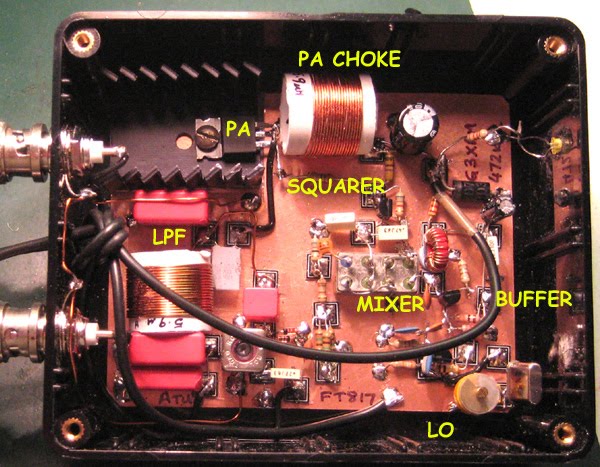
Although not available commercially, another popular 630m homebrew design is one from G3XBM which will also provide a way to get on the digital modes. He also has a 2200m design, should your interests be focused on that band.

G3XBM -630m Transverter
Any of these simple transverters are capable of controlling a higher-powered switching FET amplifier as your station progresses.

If you want something in the 'Collins category', the tranverters (both 2200m and 630m models) produced by VK4YB's Monitor Sensors provide around 70W output and are incredibly well designed and built. I have been very happily employing a 630m model for well over a year now ... my review of the transverter can be found here.

VK4YB - 630m Transverter
I suspect that we may soon see more commercial products become available over the next year but if you are handy with a soldering iron, building your transmitter will all be part of the 630m challenge!

I would like to put on a beacon. What do you suggest?

The best and most informational type of beacon is a WSPR mode beacon. A WSPR beacon operator can always determine where his beacon is being heard, in real time, along with how well it is being heard, by watching the uploaded 'spots' of his beacon on the WSPRnet. You will have much better coverage with this weak-signal mode beacon compared to one on CW ... for every CW report received, you would likely get ten times or more that number on WSPR.

Although WSPR is a great mode for checking out propagation, it's very easy to get into the habit of nightly beaconing and not developing your station any further. If you do run a WSPR beacon, be sure to try some of the other two-way modes such as CW or JT9 and call CQ regularly ... ham radio is all about making two-way contacts!

I don't have enough property for the large antennas required, so I won't be able to use these bands.

Even if you are limited in space, you can still enjoy these bands. There are many examples of stations on small city or suburban-size lots that are consistently heard across North America on 630m. If you have the room for an 80m or 40m dipole or inverted-L, that will be enough space to work these bands. An inverted-L for example, can be base-loaded and tuned to resonance. Along with several ground radials, even a small antenna system like this will allow you to work skywave DX or be heard across the country when propagation is good. I'm constantly amazed at how well these bands propagate with very low amounts of erp. Don't let living on a small lot stop you from exploring these bands!

All I hear is noise on these bands ... how can I use them if I can't hear anything?

Growing noise floors are common to everyone and this is often the biggest challenge for LF and MF operators, especially those in densely populated regions. Armed with a little knowledge and investigation, oftentimes seemingly impossible QRN can be substantially reduced if not eliminated entirely ... even easier when the noise source is found to be in your own home! While some amateurs just give up at this stage, most will see it as an interesting challenge to be overcome and part of the many learning experiences offered by these new bands.

In addition to the informational links provided above, I have just added a new 'Getting Started On 630m' page to my website. This page has a two-part article that I recently wrote for The Canadian Amateur, our national amateur radio journal. The articles describe a simple way of getting on 630m CW as well as providing some basic antenna information and ideas.

This blog also has extensive writings involving 630m over the past few years, describing equipment used and suggestions for new operators, much of it involving homebrewing. There are several links on the right that will take you to specific blogs dealing with 630m.

For present LF and MF operators here in Canada, the arrival of our American friends to these bands is generating much excitement and anticipation. The opening of these bands in the USA will pump new life into this part of the spectrum for all North American participants and the opportunities for homebrewing and experimenting are boundless. It should be a very exciting winter!

If you have not taken the 60 seconds required to register your station on the UTC webpage, please don't neglect to do this via the link provided above. There have, reportedly, been thousands of amateurs doing this already, as it effectively locks-out their locations for any future PLC deployment that might keep them off these bands at a later date.

See you in mid-October on 630!

Wednesday, 7 June 2017

May Moonbounce / More 6m WSJT Observations

Late May's EME activity seemed poorer and less active than the previous month of northern declination moonrises.

Unlike winter's northern moonrises, the summer ones occur close to 'new moon' time and for a few days on the much favored northern path, the moon is too close to the sun, resulting in lower activity and higher noise. As well, with the warmer summer weather, outdoor projects or other summer activities often take priority over ham radio operations at this time of the year.

Nevertheless, I did manage to work five stations with my small station, and added four 'new initials', bringing my total unique-station QSO total to 105 ... it seems there are still plenty of folks out there that I have yet to work!

  • VE1KG
  • OK1DIX #102
  • S53K #103
  • IK1UWL #104
  • OZ1CT #105

IK1UWL's 4 x 9el cross-polarized array

S53K's 4 x 11el array

OZ1CT's 4 x 10el cross-polarized array

Latest Incoming EME QSLs:


With the summer Sporadic-E season now in full swing, I've had the opportunity to make some early observations regarding the growing use of the weak-signal digital modes. It seems my previous suspicions about the migration from traditional modes to the digital modes is occurring even more rapidly and in much larger numbers than I had expected. Almost all early activity has been concentrated on both JT65 and JT9 modes and most of the chatter on the ON4KST 6m chat page centers around these digital modes.

So far this season I have heard much more DX on JT65 than on CW or SSB, including two stations in Europe on Tuesday (EI4DQ and F5LNU). It seems that many QSO's are taking place with signals that are usually too weak to be heard by ear (~ -16db or weaker) and if listening for CW signals, the band would appear to be pretty much dead. With no full-blown openings to Europe yet, I just wonder if stations will stay put on JT65 or move to the much faster CW mode for making quick contacts when the propagation allows?

Making JT65 contacts is not a particularly fast process, with most QSOs taking a minimum of four minutes, if both operators are well acquainted with the procedures ... longer if not or if QRM or propagation throws a spanner into the works. Some of the newer JT9 sub modes allow for quicker exchanges as does the much less sensitive MSK144 mode but with so many options now available, it's often difficult to get everyone on the same mode or at least figure out what mode you are seeing!

I can see the advantages of using these modes when conditions will not support CW but will still allow digital decodes. If the normal 'weak signal window' can be sustained for a much longer time period than the usually short-lived audible CW-level window, perhaps more stations could actually be worked on these modes even though the QSO rate is much slower. But I still think that many easy CW QSO's will inevitably be missed when operators are watching their digital waterfalls and ignoring the CW end of the band ... of course, if everyone is doing that, then there will be nothing to be heard on CW, even though conditions may well support good signals.

It's a strange new situation and I'm probably not the only one that may be worried about the negative effects of the new weak-signal modes on 6m ... time will tell, but for me, if things keep going along this path, much of 6m's magic may be gone along with it.

Some other initial observations are:

- maybe it's possible to work more DX on weak signal mode, even though it is slower, because of the possibly longer propagation window at sub audible signal levels? ... ie. on a seemingly 'dead band' by ear.

- many are using the wrong sequence when calling for EU or JA. Folks need to pay attention to what sequence the DX is using!

- if your neighbours are running on even or odd sequence, then it might be neighbourly to also use the same sequence to avoid causing disruptive QRM. This seems to go south fast, once the band breaks wide open and it seems like 'every man for himself' ... not unlike 50.125!

- there are too many weak-signal modes and it would be advantageous to settle on a 'standard' mode for 6m DX. It seems as though many are wasting valuable time either switching modes or trying to figure out what mode they are seeing but not decoding! On long haul 6m Es, things change too quickly to waste time.

- there are still a lot of over-driven signals or signals with 60Hz components causing double decodes +/- 60Hz from their main signals.

Saturday, 3 June 2017

Digital Revolution Or Evolution?

courtesy: KD0WTE


A recent reflector posting tended to confirm a rather intriguing trend that I have also been noticing over the past few years.


The poster lamented the fact that he often found very few or even no CW / SSB signals on the HF bands while at the same time seeing lots of activity throughout the digital portion of the bands.

It does seem like there is far less CW and phone activity on the HF bands now, than there was a few years ago and there is no question that digital activity has soared. Whether it's RTTY, PSK31, JT65, WSPR, JT9 or others, these digital signals are always prominent and, band plan or not, are slowly migrating further in the band as activity increases ... but is this the reason for the decline of traditional modes?

The digital weak-signal modes make these extremely popular for a number of reasons. Nowadays, many amateurs are living in antenna-restricted communities and are forced to develop smaller, lower and less effective stealthy antenna systems if they wish to get on the air and make contacts. Most of these modes perform well with minimal amounts of power and are capable of hearing well into the noise ... and unless you live out in the country, with well-separated neighbours, we all know that noise is increasing at horrific levels almost everywhere. These two factors alone might well explain much of the growth in digital activity.

Licencing requirements have also been slowly evolving and today, getting a ticket is much easier than it was several decades ago ... and in many cases, without the requirements of knowing anything about CW. Every month, North Americans see a large number of new amateurs, many with no code skills and possibly not much interest in acquiring them. From my own local observations, most of these new amateurs usually head straight to FM on the VHF/UHF bands and have little knowledge of or interest in HF radio. These factors must also play into the demise of activity on the traditional HF modes as well.

We also shouldn't overlook the influence that Old Sol is having on our HF bands as well. Solar Cycle 24 (begun in 2008) has been one of the poorest on record and continues to generate month after month of terribly poor HF propagation. As a young SWL who listened in Cycle 19, (the largest on record), I can vouch for the relationship between HF activity and good propagation. Those were amazing days, when 20 and 15m would stay open all night long ... even 10m would often still be open with F2 propagation at midnight towards VK and ZL! Everyday, month after month, the bands were simply bulging with activity, from end to end ... high solar flux numbers bring high activity numbers and we are now experiencing the downside effects of what happens when the sun dreadfully underperforms. The only exception to band-bulging activity today seems to be limited to major contest weekends only. Where these people go the rest of the time is a mystery.

There are surely other reasons as well for the gradual decline of traditional-mode HF activity, including the fact that the general ham population is getting older. Large numbers of stations are simply 'going away' as interest or opportunity declines and as more of the aging traditional-mode ops go 'SK'. I know of several hams that have just given-up because of insurmountable increases in their local noise floors. Our new and usually younger hams, have largely grown up in the 'digital age' and for those that do find themselves exploring the HF bands without CW skills, might logically settle into the digital modes first.

Things are changing quickly, of that there is no doubt. Last summer, on 50MHz, I noticed a large increase in the number of dedicated CW operators moving to JT65 and JT9 during openings and this summer has already seen another huge migration from one mode to the other.

Although this year's Sporadic-E season is just getting started, I have already heard many more countries on JT65 than I have on the traditional modes (Japan, Philippines, China, Formosa, Alaska, Venezuela, Cuba, Brazil). Yesterday I listened to a PY calling CQ on CW for some length, with no takers, while it seemed most of the usual west coast ops were watching the digital band. I fear that many good QSO possibilities will be lost as more stations switch to the much slower digital modes ... on 6m, many of the openings last for a very short time making CW or SSB the quickest way to complete a contact. The other problem I notice this summer is that there are several JT sub-modes and it is often difficult or impossible to figure out which mode is being used let alone having the time to switch to the other mode before signals are gone ... perhaps a case of having too much of a 'good thing'? Hopefully one mode will emerge as the '6m standard' so all are on the same page.

What will be the long-term outcome of these changes remains to be seen but I suspect we'll see more and more of our HF CW and SSB spectrum space gradually shrinking to make room for more digital activity, likely to become the dominant modes eventually.

As a life-time, almost exclusive CW operator since age 15, I find this somewhat disheartening but must admit that over the past few years, I have found my own level of weak-signal digital activity increasing by leaps and bounds. These are powerful, capable modes and offer amateurs new and exciting challenges from VLF to nanowaves. Are they as exciting as my much-loved CW? Ask me in a couple of years!

Tuesday, 24 January 2017

ZF1 - VE7 On 630m


Early last night ZF1EJ (Eden) and I were able to easily complete a two way JT9 QSO on 630m ... 475.300 kHz to be more exact.


This was Eden's first 630m JT9 QSO as well as the first ever 630m QSO between Canada and the Cayman Islands. The contact was completed shortly between 8:15 and 8:30 PM local time. The contact attempt was initiated via the ON4KST 2200m / 630m chat page after I had decoded Eden's signal shortly before 7 PM local time ... the first time I have seen his signal so early in the evening.

Eden was using a VK4YB Monitor Sensors Transverter and a newly deployed transmitting antenna described below in the KB5NJD Daily 630m Report:

"This is how the antenna is setup:- It is a tophat vertical, the tophat is 65’ 6” long and about 80’ above ground, the vertical is 74’ 6”, There are 4 radials 10’ above ground, each 128’ 6” long. The antenna is made of #10, stranded insulated wire. The tophat is strung between two towers and is side on about 45 deg. The tuner was built by Ron and Ward a few month ago and shipped down to me. Just found the time to set it up recently. The SWR is 1.1-1 and I am using a Monitor Sensors Transverter built by Roger, VK4YB. Output to antenna 22 watts."

The only change to the above report was Eden's e-mail follow-up indicating that his power output during our QSO was 32 watts ... conditions must have been even better than I thought.

JT-9 Screen At VE7SL
There is no question that his antenna works very well as his signal was decoded on every transmission following my first reception of his JT9 signal. Conditions appeared to be good enough that we could have continued the contact for some time as there was little fading during the time of our QSO. Later in the evening, signals at his end reached well into CW levels for considerable time while just one WSPR transmission from Eden was received at CW levels.

With an even newer JT-9A mode now promising a 2db improvement, making contacts should be even easier. Once the USA gets access to 630m, it is clear that Eden will be a popular target for most North American stations!

Friday, 11 November 2016

Saturday's 630m Crossband Night - Reminder


This is a reminder of tomorrow's '630m activity night'. Highlights of the evening will see six different Canadian stations seeking contacts with other amateurs in North America via the 'crossband mode' as they call CQ on 630m CW but listen for replies on their announced (QSX) HF frequency. As well, there will be an increased level of on-air activity from many of the U.S. experimental stations, as they beacon or work each other on various modes including CW and JT9, the WSPR QSO-mode. The experimental stations are also seeking your reception reports.

More information may be found here regarding the activity night, including a detailed list of participating Canadians along with their respective transmitting and QSX HF listening frequencies.

As is often the case, old 'Sol is threatening to throw some junk our way over the next day or two, right on time for our event but please don't let that stop you from participating as often this can actually enhance propagation, especially on the north-south path.

We hope to see many of you tomorrow night!

Tuesday, 11 October 2016

VE3 - VE7 630m QSO


The 630m band continues to provide interesting challenges for Canadian amateurs ... be they antenna, equipment or propagation related.


Sunday night produced another flurry of excitement on the new band, further demonstrating its potential for small stations operating from the suburbs.

On Sunday evening, VE3CIQ in Carleton Place, Ontario (southwest of Ottawa), and I, completed a two-way JT9 contact, following a short exchange of the required information (and more) just after midnight, Ontario time.

courtesy: https://www.google.ca/maps/

Noting the increased east-west favorability over the past few nights, Phil and I decided to give it a shot and were delighted to cover the 2200 mile / 3500km path while Murphy was sleeping and not messing with propagation.

Rather than randomly beacon on JT9, we both set 'calling each other' messages. Although this continued for some time, the QSO only took 12 minutes to complete once I started to decode Phil's signal out west. He had been decoding me and sending signal reports for a long time before his signal eventually peaked up here for the evening. I suspect that we could have continued the contact for the remainder of the night as his signal was getting stronger and stronger as we worked.

Screen shot of QSO from VE3CIQ's end
Following our QSO, Phil sent me some information about his station. His transmitter consists of a Yaesu FT-817 driving an XKA transverter which in turn drives his homebuilt class-E amplifier. The amp consists of three switching FETs in parallel, operating at 24V and produces about 175W out.

VE3CIQ - 630m Station

VE3CIQ - Homebrew 630m Class-E Transmitter
Phil's antenna is an 'inverted-L' style ... 45' up to the top of a Pine tree and then a very very long sloping top hat wire, folded back on itself three times, in a zig-zag pattern. This use of linear-loading allows him to squeeze a near full 1/4 wave antenna into his suburban lot as well as to reduce the size of his loading coil inductance. His ground system consists of ~3,000' of buried radials. By all accounts, it seems to perform very well as his WSPR beacon was recently heard in Hawaii!

VE3CIQ - 630m Linear-loaded Antenna


Phil's station stands as yet another fine example of those living in the suburbs without a lot of room for antennas yet still able to successfully operate and explore our new 630m band. With a little ham-radio creativity, it's surprising how well a small station can perform, especially when the propagation co-operates.


Following our contact, I moved back to the WSPR section of the band and continued beaconing overnight.


Apparently Phil and I picked a good evening to run a sked as the overnight WSPR map shows it to have been the best night of the new DX season so far, with forty-four individual stations reporting my signal via the WSPRnet website.

courtesy: http://wsprnet.org/drupal/
Interest and activity on 630m continues to grow nightly, now that the DX season has arrived and the reality of a 630m ham band for U.S. amateurs grows ever closer.