Showing posts with label loops. Show all posts

Monday, 23 September 2019

Recent BCB Loop DX / Upcoming CLE248

This past week has seen a welcome return to better band conditions on the lower frequencies.

I’ve had my 10' x 20' loop and Perseus SDR combination running a few overnight recordings on the AM broadcast band ... two mornings pointing at Asia and two overnights looking for domestic signals from the east.

The Asian signals have often been very strong, with many signals reaching S9 or higher. I’ve chosen some of the better ones below. Unlike those situated right on the west coast, my location here on Mayne Island gives me a nice shot towards Japan albeit not directly over the ocean, but close enough, as the path crosses islands to my north and then over northern Vancouver Island.

Looking towards eastern North America is a different story, with an unobstructed ocean view from due north to the south east.

As is often the case with overnight recordings, I did not get nearly enough time to thoroughly check them out but one catch caught my attention. It was from WPTX in Lexington Park, Maryland, on 1690kHz. This station supposedly runs 1kW at night and 10kW during the day but on this night (Sept 16), I heard their top-of-hour ID for three consecutive hours! I wonder if someone ‘forgot’ to switch to nightime power or if conditions were just really good? I have heard them again since with two TOH IDs but much weaker and sounding more like a 1kW station should sound!


JOAK - 594kHz in Shobu, Japan (13:30 UTC Sept 20)


JOUB - 774kHz in Akita, Japan (14:00 UTC Sept 20)
(with English lessons)


HLAZ - 1566kHz in Cheju, South Korea (13:30 UTC Sept 20)
(broadcasting in Japanese in this time slot)


Voice of America (VOA) - 1575kHz in Ban Phachi, Thailand (13:30 UTC Sept 20)
(listen for "This is the Voice of America" ID and then into "Yankee-Doodle-Dandy")


                                   ************************

Hunting For NDBs In CLE248


Yes! Another month has passed and it's CLE time once again.

This time the hunting grounds will be: 275 kHz - 425 kHz.   

For those unfamiliar with this monthly activity, a 'CLE' is a 'Co-ordinated Listening Event', as NDB DXers around the world focus their listening time on one small slice of the NDB spectrum.

If you've been meaning to participate in  CLE, then maybe this weekend is a fine time to try! Lately, we've had a lot of first time submissions so you won't be alone!

As well, if you're trying to learn CW, copying NDBs is perfect practice, as the identifier speed is generally slow and the letters are repeated again every few seconds!

At this time of the season, summer lightning storms should be starting to wane and propagation can often be as good as mid-winter if the lightning cooperates.

When tuning for NDBs, put your receiver in the CW mode and listen for the NDB's CW identifier, repeated every few seconds. Listen for U.S. NDB identifiers approximately 1 kHz higher or lower than the published transmitted frequency since these beacons are modulated with a 1020 Hz tone approximately.

For example, 'AA' near Fargo, ND, transmits on 365 kHz and its upper sideband CW identifier is tuned at 366.025 kHz while its lower sideband CW ident can be tuned at 363.946 kHz. Its USB tone is actually 1025 Hz while its LSB tone is 1054 Hz.

Often, one sideband will be much stronger than the other so if you don't hear the first one, try listening on the other sideband.

Canadian NDBs normally have an USB tone only, usually very close to 400 Hz. They also have a long dash (keydown) following the CW identifier.

All NDBs heard in North America will be listed in the RNA database (updated daily) while those heard in Europe may be found in the REU database. Beacons heard outside of these regions will be found in the RWW database.


From CLE organizer Brian Keyte, G3SIA, comes the details:

Hi all

Our 248th Listening Event just squeezes into the last weekend of this month.
Worth waiting for because it is a 'Special', our fifth 'Channels Challenge'.
It's a simple idea, but one that we always seem to enjoy:

    Days:      Friday 27 September - Monday 30 September
    Times:     Start and end at midday, your LOCAL time
    Range:     275 kHz - 425 kHz   (see below)
    Target:    Try to log ANY ONE NDB in each channel

The 'channel' means the NDB's nominal (published) frequency.
EITHER  321.0  OR  321.5 kHz would be OK for channel 321, etc.

So it means a possible maximum of 151 loggings in all, though that would
probably be miraculous, even for the best placed of us!

All the NDBs must be 'normal' ones (no DGPS, Amateur, etc.) and
no UNIDs in your main list.   Yes, it does include those more
challenging frequencies in the DGPS range.

If you want to add extra interest you could also choose to:
    Maximise the number of radio countries you hear    or
    Maximise the total distance to the NDBs you hear    or
    Maximise the number of 'midday' loggings - i.e. NDBs logged
      within 2 hours of midday by your local winter clock time.

It will be extra tough for North American listeners, with their many 'empty'
channels. Southern Hemisphere and Europe listeners should be more lucky.

Our last 'Channels Challenge' was CLE231 in April 2018.
Please look out for the 'Final Details' a few days before the start.

73
  Brian
-------------------------------------------------------------------------
From:   Brian Keyte G3SIA               (CLE coordinator)
ndbcle'at'gmail.com
-------------------------------------------------------------------------

These listening events serve several purposes. They:
  • determine, worldwide, which beacons are actually in service and on-the-air so the online database can be kept up-to-date
  • determine, worldwide, which beacons are out-of-service or have gone silent since the last CLE covering this range
  • will indicate the state of propagation conditions at the various participant locations
  • will give you an indication of how well your LF/MF receiving system is working
  • give participants a fun yet challenging activity to keep their listening skills honed

The NDB List Group is a great place to learn more about the 'Art of NDB DXing' or to meet other listeners in your region. There is a lot of good information available there and new members are always very welcome. As well, you can follow the results of other CLE participants from night to night as propagation is always an active topic of discussion.

You need not be an NDB List member to participate in the CLEs and all reports, no matter how small, are of much value to the organizers. 

Remember - 'First-time' logs are always VERY welcome!

Reports may be sent to the NDB List Group or e-mailed to CLE co-ordinator, Brian Keyte (G3SIA), whose address appears above. If you are a member of the group, all final results will also be e-mailed and posted there.

Please ... give the CLE a try ... then let us know what NDB's can be heard from your location! Your report can then be added to the worldwide database to help keep it up-to-date.

Have fun and good hunting!

Wednesday, 28 August 2019

My 10’ x 20’ Active Loop

courtesy: americanradiohistory.com


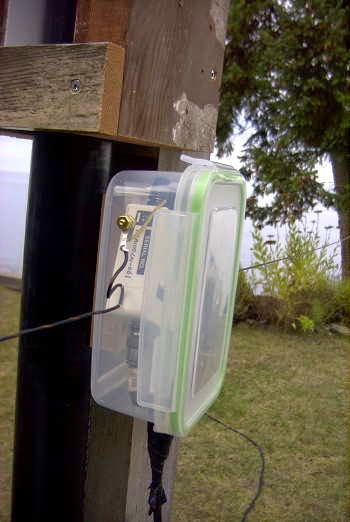
After recently installing a new coax run out to the loop and after five years of summer sunlight, the plastic food-storage container used to house the loop’s preamp (Wellbrook ALA100LN ... LF-30MHz) finally bit the dust ... literally.


Last week I replaced the housing with a slightly larger plastic box but I’ll still be faced with the UV bombardment and eventual deterioration of the clear plastic and lid unless I do something different.


I’ve a couple of thoughts but am hoping for some other suggestions from blog readers.

I have thought about spray painting the container, which may (or may not) prevent UV damage, but wonder if paint will stick to the smooth plastic surface? Maybe if scuffed-up a bit it would stick ... if so, the coating could be annually renewed.

Another idea is to cover it with duct tape ... not pretty, but possibly doing the job. Any other thoughts out there?


Part 2 and Part 3 of this blog were originally published when the loop was first built (2014) and describe the antenna details as well as showing the loop in action ... listening on the NDB and broadcast band as well as showing its nulling capability. It’s been a great performer and  I can highly recommend the ALA100LN for a large aperture receiving loop. I’m looking forward to what will hopefully be a good winter of exciting loop DXing.

Part 2 - New LF / MF Loop


Some may recall my blog back in July (Wellbrook Loop Plans) describing a new loop that I had been thinking about as a possible replacement for my 10' shielded loop. I had been doodling various construction ideas using PVC tubing in an effort to keep it as light as possible, without introducing any metal near the loop. On Monday of this week, I dismantled the 10' loop in preparation for my new experimental rectangular loop.
I've had the Wellbrook loop preamp here for a few months, so it was now or never, while the weather was still 'antenna-friendly'. Now I do understand that this goes against one of ham radio's long-standing traditions that dictates all antenna work must wait until the weather can't get any worse. Antennas built in the winter rain always work much better than ones put up in the summer. Hopefully it's not Wouff-Hong or Rettysnitch punishable but the fall DX season is almost upon us and I'm not waiting for the rain!

The new 'loop' is not really loop-shaped but is rectangular (10' x 20') and more like a Flag antenna shape. I considered a Flag but really don't need any back-end nulling capability since I'm mainly interested in listening to the east and to the north.


The main boom section is composed of two sections of 1" PVC thick-wall (Schedule 40) pipe joined at the center and reinforced with a 10' section of 2" x 2" Douglas Fir. In addition, the boom has a truss of 1/4" Dacron to take out any end-loading sag. The vertical end sections are 3/4" Schedule 40 PVC pipe, fastened with a T at the boom end. The center mast is made of 2" Schedule 40 ABS pipe with a long section of 1 1/2" ABS nested inside that telescopes upward to anchor the truss ropes and give some additional rigidity to the mast.


Main boom and mast construction
This type of construction would lend itself well to anyone interested in a rotating Flag antenna for the BCB / LF or 160m. The costs are very low, the structure is lightweight and the materials are readily available at most hardware outlets.


Looping E/W


Although the preamp is completely sealed and weatherproofed, I still decided to mount it inside a container. The container also provided a convenient anchor to terminate the loop end wires (PVC-coated #18 stranded) without putting any tension on the soldered terminals.

Although I have not had much time to listen, and conditions are still in 'recovery' mode from earlier disturbances, initial indications are that everything is performing as well, if not better, than expected. It certainly outperforms my 10' active shielded loop by a large margin. I have yet to do any serious S/N comparisons between it and my primary LF receive antenna, a large inverted L, which must be tuned to resonance for the desired listening range. I believe that the very quiet loop / Wellbrook combination will provide an overall S/N improvement.

I have always believed that smaller loops provide deeper and sharper front-to-side nulls so I was pleasantly surprised to measure (using Perseus) null depths from 25-30db, on various groundwave signals ... more than expected. Skywave signals also deliver sharp deep nulls in the order of 22 - 25db ... again surprising, but I'll take them!

A brief listen while pointing S-E last evening turned up good signals from 1 kW'ers KYHN (1650kHz) in Fort Smith, Arkansas and KKGM (1630kHz) in Fort Worth, Texas. An early morning listen revealed good audio from JOIK (567kHz) Sapporo, Japan and JOAK (595kHz) in Shobu. Down in the ndb band, little 25-watter 'IP' on 210kHz was an all-time new catch from Mobile, Arizona.

There is still much to learn from this new antenna system but the biggest challenge will be keeping it up all winter. I did lose one of my 10' loops after several years, due to wind, when the main (un-reinforced) PVC mast eventually failed from flexing fatigue. I will tie the ends of the new antenna down when the winds get strong to reduce as much mast flexing as possible. I could however, run the risk of violating another long-standing radio adage ..."if your antenna stays up all winter, it's not big enough". I just can't win.

Part 3 - Loop Listen 


As Murphy would have it, and in spite of the low amount of solar activity, LF/MF propagation has been very poor since getting my new 10' x 20' loop in place. The few front-to-side nulling checks that I have done, have produced results varying from around 20db to 30db, depending upon the signal. I suspect the depth of null is also affected by the signal's arrival angle but there is still more to learn. The pattern seems to be very close to that of a typical circular loop...the classic figure-8 pattern illustrated below as shown on the Wellbrook data that came with my ALA100LN preamp.

Courtesy: http://www.wellbrook.uk.com

More typically, the null is around 21-22 db as shown on this test while listening to the ground wave carrier of the 'YZA' NDB (236kHz) located in Ashcroft, B.C., about 150 miles to the NE. As expected, the null is fairly sharp and the front / rear lobe, fairly broad.


One short check at dusk produced nice signals from  CJBC, the French-language station in Toronto. The past few nights it has been very strong but with a strong echo effect. I wonder if there is more than one CBC outlet here (860kHz), such as a low-power repeater, causing the echo.


At the same time, while still fairly light outside, WCCO in Minneapolis had a nice signal just before sunset.


No matter how poor conditions become, it seems that the Hinchinbrook (Alaska) NDB, 'ALJ' (233kHz), is always strong ... looping north.


Courtesy: https://www.google.ca/maps
My apologies for the video quality. If you know of any software available for making full-screen Perseus video captures so that I might improve my technique, please let me know. Presently I am just capturing them on my I-Pad which leaves a lot of room for improvement.

(Since originally posting the above, I have been using the Tiny Take free screen capturing software, to produce better quality catures of my Perseus recordings. It's also probable that my new iPhone would produce a high quality video of my computer screen compared to the older iPad used for these ones, but it's something yet to be tried.)

Hopefully conditions will only get better as the season progresses and I am able to give the loop a good workout ... before it gets too windy!

Wednesday, 26 September 2018

CLE236 Results

courtesy: https://sdo.gsfc.nasa.gov/


It seems that for the CLE236 listeners in western North America, my worst fears came true. The week preceding last weekend's listening event had seen great MF propagation and quiet geomagnetic conditions.


On Friday evening, shortly after the start, a geomagnetic storm commenced, with K-levels reaching 5-7 at various stations ... pretty much sounding the death knell once again. It seems more than coincidental that almost every CLE in the past few years has seen horrific geomagnetic conditions in lock-step with our scheduled monthly events!

Since there were no active regions on the Sun at the time, I suspect, as mentioned in my last blog, that we were victimized by a sudden spurt from the same coronal hole that whacked us last month, as it lined-up once again on its monthly reappearance. Arriving on Friday evening as sunset approached, the effects seemed to spare the rest of North America (and Europe), as western listeners were the only ones reporting poor propagation. As well, lightning noise, often abating by this time of the year, created havoc for many listeners ... even those with good propagation.

I can only hope that next month's event will see a major improvement in noise levels as well as in propagation quality. Hopefully, that pesky coronal hole will have closed itself by then!

On top of the above mentioned challenges, CLE236's frequency range was smack on top of my local pest, AP-378, whose antenna is less than one mile from my own antennas. Having an S9 +60db signal in the middle of the narrow CLE range does make for challenging listening. My 10' x 20' loop knocked AP's signal down about 25db, allowing me to hear the following signals, some only barely.


22 05:00  371     YK         Yakima, WA, USA
22 07:00  371     GW        Kuujjuarapik, QC, CAN
22 10:00  372     ZPA       Prince Albert, SK, CAN
22 06:00  372    YCO       Coppermine, NU, CAN
22 08:00  373    MF         Table Rock, OR, USA
22 11:00  374     EX          Kelowna, BC, CAN
23 11:30  374     EE          Forada, MN, USA
22 11:00  375     FS          Fort Simpson, NT, CAN
22 12:00  375     CP         Casper, WY, USA
24 08:00  376   YAG       Fort Frances, ON, CAN
22 07:00  376    K2         Olds-Didsbury, AB, CAN
23 06:00  378    OT         North Bend, OR, USA
22 06:00  378    AP         Mayne Island, BC, CAN
23 11:30  379     OW        Owatonna, MN, USA
23 11:30  379     DL          Duluth, MN, USA
23 05:00  380   GC         Gillette, WY, USA
24 06:00  380   BBD      Brady, TX, USA
22 07:00  382   YPW      Powell River, BC, CAN
24 13:00  382    JNR       Unalakleet, ALS
22 13:30  382     AW        Marysville, WA, USA
22 07:00  383    PI           Pocatello, ID, USA
22 07:00  383    CNP       Chappell, NE, USA
 
See you in CLE237.

Tuesday, 12 July 2016

Nightly 75kHz WSPR Activity From Arizona - WH2XND


2.5mH 136kHz loading coil at WH2XND

For the past few weeks, Ron, NI7J in Phoenix, has been activating his experimental station, WH2XND, in the LF band ... on 75.550kHz (WSPR), where he is licenced to operate.

Last night I decided to put my nightly 630m WSPR beacon on hold and have a listen for Ron's signal using my 10' x 20' loop.


Ron's main experimental operating has been on 630m and 2200m WSPR mode but his recent activity on 75kHz has sparked a lot of interest among dedicated summertime listeners. WH2XND is licenced for 10W ERP on 75kHz, not a number that's easy to muster considering the poor antenna efficiency produced by typical amateur installations ... however, judging from Ron's coils, his installation looks far from 'typical'!

Ron's signal is being well heard, even up in Alaska, in spite of the noisy summer conditions and it will be interesting to see how well it propagates once we move into the fall and quieter winter nights.

The big loop seemed to do well with Ron's signal last night, resulting in 55 decodes starting at around 2300 local time and continuing to sunrise.

Timestamp                    Call                   SNR         Grid  
  
2016-07-12 12:28      WH2XND            -28            DM33xt     
2016-07-12 12:20      WH2XND            -27            DM33xt     
2016-07-12 12:16      WH2XND            -25            DM33xt     
2016-07-12 12:12      WH2XND            -28            DM33xt     
2016-07-12 12:08      WH2XND            -27            DM33xt   
2016-07-12 12:04      WH2XND            -28            DM33xt     
2016-07-12 12:00      WH2XND            -29            DM33xt     
2016-07-12 11:40      WH2XND            -25            DM33xt     
2016-07-12 11:36      WH2XND            -20            DM33xt     
2016-07-12 11:32      WH2XND            -18            DM33xt     
2016-07-12 11:28      WH2XND            -18            DM33xt     
2016-07-12 11:24      WH2XND            -19            DM33xt     
2016-07-12 11:20      WH2XND            -19            DM33xt     
2016-07-12 11:16      WH2XND            -20            DM33xt
2016-07-12 11:12      WH2XND            -20            DM33xt     
2016-07-12 11:08      WH2XND            -19            DM33xt      
2016-07-12 11:04      WH2XND            -19            DM33xt      
2016-07-12 11:00      WH2XND            -20            DM33xt     
2016-07-12 10:56      WH2XND            -20            DM33xt   
  
2016-07-12 10:52      WH2XND            -21            DM33xt      
2016-07-12 10:48      WH2XND            -22            DM33xt      
2016-07-12 10:44      WH2XND            -23            DM33xt      
2016-07-12 10:40      WH2XND            -24            DM33xt      
2016-07-12 10:36      WH2XND            -25            DM33xt      
2016-07-12 10:32      WH2XND            -26            DM33xt      
2016-07-12 10:28      WH2XND            -24            DM33xt      
2016-07-12 10:24      WH2XND            -24            DM33xt      
2016-07-12 10:20      WH2XND            -25            DM33xt     
2016-07-12 10:16      WH2XND            -24            DM33xt     
2016-07-12 10:12      WH2XND            -23            DM33xt      
2016-07-12 10:08      WH2XND            -26            DM33xt      
2016-07-12 10:04      WH2XND            -25            DM33xt      
2016-07-12 10:00      WH2XND            -26            DM33xt      
2016-07-12 09:56      WH2XND            -26            DM33xt      
2016-07-12 09:52      WH2XND            -27            DM33xt      
2016-07-12 09:40      WH2XND            -26            DM33xt      
2016-07-12 09:36      WH2XND            -25            DM33xt     
2016-07-12 09:32      WH2XND            -24            DM33xt      
2016-07-12 09:28      WH2XND            -26            DM33xt      
2016-07-12 09:24      WH2XND            -26            DM33xt      
2016-07-12 09:20      WH2XND            -28            DM33xt      
2016-07-12 09:16      WH2XND            -27            DM33xt      
2016-07-12 09:08      WH2XND            -27            DM33xt      
2016-07-12 09:00      WH2XND            -27            DM33xt      
2016-07-12 08:56      WH2XND            -28            DM33xt      
2016-07-12 08:52      WH2XND            -29            DM33xt      
2016-07-12 08:44      WH2XND            -29            DM33xt      
2016-07-12 08:40      WH2XND            -27            DM33xt      
2016-07-12 08:36      WH2XND            -28            DM33xt      
2016-07-12 06:44      WH2XND            -32            DM33xt      
2016-07-12 06:32      WH2XND            -31            DM33xt      
2016-07-12 06:28      WH2XND            -31            DM33xt      
2016-07-12 06:24      WH2XND            -30            DM33xt      
2016-07-12 06:20      WH2XND            -30            DM33xt     
2016-07-12 06:12      WH2XND            -29            DM33xt  
    

His signal peaked here (shown in blue above) about an hour before sunrise, with almost a dozen decodes in the -18 to -20 region ... not far from audible CW levels which will probably be seen in winter. It was interesting to note as well, that in several transmitting sequences, Ron's signal was stronger in Alaska than it was here and in Washington state ... just the opposite of what one might expect.

In the past, I have had good results on 75kHz with Dex (W4DEX), when listening for his QRSS CW signal, using my normal inverted -L with a 2.5mH RFC inserted in series with the antenna's normal loading coil.


'XRS/5' on 75kHz from W4DEX in NC
If you can give a listen for Ron's WSPR signal and send him a report ... or better yet, upload your spots to the WSPRnet site, he would be very appreciative. For listening, set your receive frequency to .074kHz in the USB mode. The software will take care of the rest. You can upload 'LF' spots with your software by setting the '.074' receive frequency in the program's normal frequency or band window.

Wednesday, 6 May 2015

A 49m Bandscan


As indicated in an earlier blog, a planned scan of the 49m band was made a few nights ago ... one at 0400Z (10PM local) and another at 1200Z (5AM local). Both had a decidedly different flavor. Frankly I was surprised at the number of broadcasters and especially the number from Asia, China mainly, heard in the morning scan. One information source I found indicates that most of the strong shortwave signals from China are more designed for jamming than for program content.

My initial impression was that many of the more interesting low power targets from Central / South America and Africa may be a thing of the past but I may be wrong. The 'news' page, of the World Wide DX Club, seems to indicate that there are still lots of juicy targets out there if you are willing to put in the time to look for them, as many seem interested in doing. There also seems to be a larger variety of DX targets available in the higher bands such as 25m and 31m.

For the most part, these broadcasters don't fool around with QRP, and their signals are pretty dominant. Conditions of late have not favored Europe or Africa so there may be more activity from these regions than I think.

The following stations were logged with the Perseus SDR along and the 10'x20' loop / Wellbrook preamp, looping E-W, at 0400Z:

5810 EWTN (inSpan) Vandiver, Alabama 500kw
5830 WTWW (rel) Lebanon, TN 100kw
5850 Sun Power Radio (RMI) Okeechobee, FL 100kw
5890 WWCR (rel) Nashville, TN 100kw
5910 NHK Radio Japan Issoudun, France 100kw
5920 WHRI (rel) s/off Cypress Creek, SC 250kw
5920 Radio Romania Galbeni 300kw
5935 WWCR (rel) Nashville, TN 100kw
5970 Radio Italia (in Portuguese) Belo Horizonte, Brazil 10kw
5980 Channel Africa s/off Meyerton, SA 250kw
5985 NHK World Radio Japan (in Span) Okeechobee, FL 100kw
6000 Radio Habana Cuba Titan Quivican 250kw
6020 Radio Gaucha s/off Porto Alegre, Brazil 10kw
6030 Radio Marti Greenville, NC 250kw
6040 Radio RB2 (in Portuguese) Curibata, PR 10kw
6050 unid  / weak
6060 Radio Habana Cuba La Habana 100kw
6070 CFRX Toronto, ON 1kw
6090 Caribbean Beacon (rel) Anguilla 100kw
6125 Deutsche Welle s/off Manama, Bahrain 250kw
6160 CKZU Vancouver, BC 500w
6165 Radio Habana Cuba La Habana 100kw
6175 Voice of Vietnam Cypress Creek, SC 250kw
6180 Radio Nacional Brazilia Brasilia 250kw
6185 XEPPM Radio Educacion Mexico City 1kw


These stations were logged at 1200Z, using the same system:

5830 WTWW Tennessee 250kw
5875 BBC Nakhon Sawan (Thailand) 250kw
5915 China Radio Int'l Hohhot 100kw
5925 Voice of Vietnam 2 Hanoi 50kw
5935 PBS Xizang Lhasa-Baiding 100kw //6110
5955 China Radio Int'l Beijing 150kw
5970 PBS Gannan Hezuo 15kw
5975 CNR 8 Beijing 100kw
5985 Myanmar Radio Yangon 25kw
5990 unid China Radio Int'l same interval sig as 5915
5995 Taiwan Xing Xing Kuanyin sign-on 10kw
6000 CNR 1 Beijing 100kw
6003 VOH Korea (S) 100kw
6015 KBS Hanminjok Bangsung 1 Hwaseong (S. Korea) 100kw
6020 weak / poss Radio Victoria Lima with time pips 3kw
6030 CNR 1 Beijing 100kw
6040 weak w/eastern music/ poss Air Jeypore India 50kw
6050 weak / poss RTM Malaysia 10kw
6055 weak w/continuous music / unid
6060 Radio Argentina Exterior General Pacheco 100kw
6065 CNR 2 Beijing 150kw
6070 Voice of Korea / in Japanese Kanggye 10kw
6080 PBS Hulun Buir Hailar (Mongolia) 10kw
6090 NHK World Radio Japan Ibaragi-Koga-Yamata 300kw
6095 KBS World Radio Kimjae (S.Korea) 250kw
6100 Radio Serbia Bijeljina 250kw
6105 Radio Taiwan Int'l Kouhu 100kw
6110 Voice of America / chinese Udon Thani (Thailand) 250kw
6110 PBS Xizang Lhasa-Baiding 100kw //5935
6115 Voice of Strait Fuzhou (PRC) 50kw
6125 CNR 1 Beijing 100kw
6155 CNR 2 Beijing 150kw
6160 CKZU Vancouver 500w / relay CBU AM
6165 Voice of Vietnam 4 Hanoi 50kw
6175 CNR 1 Beijing 100kw
6180 CNR unid but time pips match other CNRs
6180 Radio Taiwan Woofferton 250kw
6195 BBC Kranji (Singapore) 125kw
6200 Voice of Jinling Manjing (Singapore) 100kw
6280.14 Unid with music / poss SOH Xi Wang Zhi Sheng Tanshui (Taiwan) 100 watts
6365 Hand sent keyer CW with callups 7CJ 7CB 7FB QTC into nr/ltr groups
6389 similar to above but nr/ltr groups
6400 Pyongyang Kanggye (N. Korea) 50kw
6501 USCG NMO Honolulu with wx bdcst
6518 Voice of the People Kyonggi-do-Koyang (S. Korea) 50kw
6518 N. Korean jammer Kujang 250kw
6600 Voice of the People Kyonggi-do-Koyang (S. Korea) 50kw
6600 N. Korean jammer Kujang 250kw
6679 Honolulu Radio w/ aviation Volmet
6754 Trenton Volmet wx bdcst


The number of broadcasters using remote sites is also surprising. It seems that the relaying of program content for others is big business and for many countries, much cheaper than running their own 250kw stations.

Some links that I have found very useful for identifying SW BC stations:

http://www.geocities.jp/binewsjp/ic/bia15.txt

http://www.short-wave.info/

http://www.shortwaveschedule.com/

Monday, 9 March 2015

State #29 On The BCB

Normally, 1660 KHz is dominated here by Spanish format KTIQ in Merced, California. I was surprised to tune past 1660 early on Saturday evening to hear Country & Western music. The top-of-hour ID was "Willie 1660 AM" who turned out to be KQWB in Fargo, North Dakota ... state #29 for me on the broadcast band! Not only was it dominating the frequency with an S9 +10db carrier, there were no other stations to be heard ... not even a whisper of KTIQ, normally heard weakly, even when looping to the east.

courtesy: https://www.google.com/maps/

Their 5 tower array is evidently doing a good job, when  propagation favors the eastern path as the antenna pattern has a strong western component while nulling the east.

courtesy: http://radio-locator.com


"... all country legends. This is a Taylor Swift-free zone, Willie at 1660 AM".

KQWB was logged at 0300Z (7 PM local time) using the 10' x 20' loop and Perseus SDR.


Sunday, 8 March 2015

New 530KHz Catch

CIAO Antenna courtesy: https://maps.google.ca/

In spite of the high K index, the broadcast band was in good shape Friday night, with a nice signal from CIAO in Brampton, Ontario. Like many of the new stations out on the west coast, this is a multi-lingual broadcaster, with most programming in Punjabi or Hindi.


Courtesy: https://maps.google.ca/

It is supposedly limited to 250 watts at night but from the sound of their signal, this regulation may not be being followed ... either that or conditions were even better than I thought.

My recording was made at 0600z (10PM local time) while looping E-W with the 10'x20' loop and the Perseus SDR.


See if you can detect the telephone numbers being given. All have an area code assigned to the Toronto region. As well, there is a second station riding beneath. I suspect one of the Cubans, Radio Reloje or Radio Enciclopedia, both on 530. There also appears to be a top-of-hour short time 'pip' ...either from the Cuban or from CIAO.

Perhaps some more experienced readers can help fill-in the blanks for me.

Friday, 27 February 2015

BCB DX - Two New States

With the recent quieting of the geomagnetic field, resulting in K values of 0's and 1's, along with a positive-going DST value, the broadcast band on Wednesday and Thursday night was much more vibrant than it has been in several weeks.

Being located on the eastern shoreline of Mayne Island, the direction towards all of the U.S.A. is over many miles of saltwater, so my main interest is in domestic / U.S.A. DX.

Wednesday evening netted two new states on the BCB ... Kansas and Indiana, for states #27 and #28 respectively, both heard on the Perseus SDR and my 10' x 20' amplified loop.

KWOD, on 1660KHz, identifying as "The Business Channel", was logged during a short top-of-the-hour fade-up at 0600z (10PM local time). Their night power is listed as 1,000 watts while their day power is 10,000 watts.

KWOD - Kansas courtesy: https://www.google.ca/maps

KWOD Towers courtesy https://www.google.ca/maps

The transmitter site is located in the middle of a quiet residential district of older homes ... on all four sides.

I shudder to think what RFI problems those living in the adjacent homes must suffer when they are on daytime power!


WSLM - Indiana courtesy :https://www.google.ca/maps


WSLM, on 1220KHz, was also logged at 0600z, during a two-minute fade-up and in the middle of the local weather report.


Interestingly, the station's night-power is listed as "82 watts", which, judging by the readability of their signal, was not the case. Perhaps the engineer just 'forgot' to switch from their daylight power of 5,000 watts!

Their phased antenna array puts their main lobes, due east and west, so evidently I was catching the northern edge of their pattern.

courtesy: https://www.google.ca/maps

See what you can hear their during the short recording made of  the "Country WSLM" weather report


I have yet to check last night's recordings to see if conditions have held-up for two night's running ... more later if so.

Sunday, 4 January 2015

House Number Four

It seems that if I'm not chasing down noisy power poles or hunting for drifting wireless headsets, both of which have tried their best to tax my 6m reception this past year, I spend several hours each year chasing down delinquent noise generators!

I spent yesterday afternoon searching the neighbourhood for the source of an annoying and disruptive 120Hz hum. Testing my patience for about a week now, the AC buzz has been ripping-into my usually quiet LF reception, disrupting efforts to participate in the latest CLE (189) listening event. Although conditions have been poor, as usually occurs during these events, the signal-shrouding AC hum has made the event a real struggle.

I had been hoping that, whatever the source of the suddenly-appearing interference was, it would disappear as quickly as it had arrived. I had first noticed it several weeks ago, but it would always go off around bedtime and often was not there at all in the evenings...but the past week it has been there 24/7.

Yesterday I had finally had enough and with Sony 2010 in hand, along with its built-in ferrite bar antenna, I tuned the radio to 630m and started walking around the neighbourhood.

The first thing I noticed was that the signal was being propagated along the overhead powerlines and it was difficult to get a direction of the true source...all nulls pointed to the closest line. Walking to the north, the signal gradually became weaker and reversing direction to the south produced an ever-increasing AC hum...progress! I eventually found a corner where the QRN peaked, and walking in all directions from that point saw the noise diminish...getting warmer!

There were four possible homes here that could be the cause of the problem. I spoke with three of the four homeowners, all of whom seemed genuinely concerned about the source. They all let me into their homes and, with radio in hand, look for the source of the (by now) loud buzz. None of the three homes seemed to furnish the nasty noisemaker.

House number four was unoccupied but was, I was told, up until about a week ago. Venturing on to the property, the S9 buzz started to climb and by the time I had reached the porch, the Sony was on the verge of self-implosion...getting very hot now! A knock on the door confirmed that nobody was home but...behind the curtain, there it was...a floor lamp was turned ON!!

With the source now located I could now breath a little easier but unfortunately could not hear any quieter. Hopefully the owners, who go back and forth to the mainland frequently, will return soon and that LF will once again sound as it should.

What could be screwed into that floor lamp? I'm betting on a poor-quality or about-to-fail CFL bulb.

The one on the left is the actual bulb that I removed from a crawlspace, about four years ago, three houses away. It had been creating the same sort of buzz, only louder, as it was much closer. It was not emitting any light whatsoever yet continued to generate noise as well as present a real fire hazard. The house occupants had left it switched 'on' in order to discourage the local otter population from making a winter home in their crawlspace. Somewhere along the line the bulb had failed and started generating large amounts of AC hum.

This one was tough to find, as even several blocks away, it was very loud. It seems that power lines make wonderful LF antennas. I had to make a map showing signal strengths at many locations to find the source... my neighbours have since given me a key to their house, just in case it happens again!

So...what do you think is in house number four?

Saturday, 20 December 2014

Large Loop On The Broadcast Band


Those of you following my blog will know that I spent some time this fall designing and building a large rotatable loop for LF and MF (BCB) work. So far the loop has met my expectations and is working well. In spite of several strong storm blasts from the southeast (70-90km), the lightweight PVC frame has shown little desire to grab the wind and destroy itself. For anyone seeking a simple and inexpensive method of mounting a rotatable loop or Flag type of antenna, I believe this mounting system would be excellent.

Over the past few weeks I have logged several new catches on the BCB with three of the highlights shown below. The two stations on 530KHz are both from Cuba...Radio Rebelde at 1Kw (Gauntanamo) and Radio Enciclopedia at 10Kw (Villa Maria). Note how the propagation this night almost puts the two signals, from opposite ends of the island, on a level playing field.


At the other end of the band, the Caribbean Beacon on 1610, from The Valley, Anguilla, has been making regular appearances with a strong signal as well.


A nice domestic catch was one-kilowatt CJEU, Radio Jeunesse in Gatineau, Quebec, operating on 1670KHz.


With the recent surge in solar flaring, the band has not been its normal December self over the past few nights...hopefully the sun will calm down and things can return to normal soon.

DXing the broadcast band was one of my very first radio activities, starting around age eleven.
I vividly recall my excitement after catching WBZ-1030 in Boston, MA on my little 5 tube AC/DC radio and loose-coupled longwire. I had been hoping to catch an ID from them after listening for them for several Saturday nights! I even managed to get a QSL for my wall, similar to this one, shortly after the big event.

It's great getting back to my radio "roots" although DXing on the BCB has changed so much over the years, with fewer stations regularly identifying and no longer signing-off at midnight. Using the Perseus SDR has also made catching idents much easier, with the ability to record the entire band for hours at a time...or as long as one's hard-drive will allow.

Wednesday, 26 November 2014

Loop..Perseus..and CLE188

10' x 20' LF Loop

As is usually the case, conditions deteriorated rapidly as the CLE weekend approached. Conditions varied throughout North America as those listening from the south-eastern regions of the U.S. reported much better propagation than those further to the northwest. Friday night appeared to be the best of the lot but all three nights were very much less than stellar.

The three-night event produced a total of 39 NDBs, with a couple of surprises.


DD UTC    kHz     Call       mi   Location
----------------------------------------------------------


22 05:00  370     YBV        1169 Berens River Apt, MB, CAN
22 06:59  370     OUN        1611 UoOk Westheimer Apt, OK, USA
22 05:00  371     YK         211  Yakima, WA, USA
23 09:00  371     PUR        1629 Marshall, MO, USA
22 05:00  371     ITU        558  Great Falls, MT, USA
22 05:00  371     GW         1946 Kuujjuarapik, QC, CAN
22 05:00  372     ZPA        824  Prince Albert, SK, CAN
22 05:00  372     YCO        1340 Coppermine, NU, CAN
22 05:12  372     FPN        675  Petersburg, ALS
22 07:00  373     TF         1191 Pueblo Mem Apt, CO, USA
22 05:00  373     MF         444  Table Rock, OR, USA
22 05:00  374     LV         776  Livermore, CA, USA
22 05:00  374     EX         190  Kelowna, BC, CAN
23 09:00  374     EE         1319 Forada, MN, USA
22 05:00  374     BOD        942  Bowman, ND, USA
24 09:59  375     PSN        1854 Palestine, TX, USA
22 05:00  375     FS         896  Fort Simpson, NT, CAN
22 10:59  375     DW         1629 Owasso, OK, USA
22 07:00  375     CP         900  Casper, WY, USA
22 05:00  375     BD         803  Moose Jaw, SK, CAN
22 07:00  376     ZIN        3326 Matthew Town, BAH
22 07:00  376     YAG        1345 Fort Frances, ON, CAN
22 13:59  376     PVQ        1690 Deadhorse, ALS
22 06:59  377     EHA        1350 Elkhart, KS, USA
23 06:59  378     ZFA        1000 Faro Municipal Apt, YT, CAN
22 05:00  378     OT         381  North Bend, OR, USA
22 10:59  379     ZEG        526  Edmonton Intl, AB, CAN
22 05:00  379     YBE        945  Uranium City, SK, CAN
23 12:59  379     IWW        1360 Kenai, ALS
22 09:00  380     OEL        1297 Oakley, KS, USA
22 05:00  380     GC         899  Gillette, WY, USA
22 05:00  382     YPW        86   Powell River, BC, CAN
22 05:00  382     YE         686  Fort Nelson, BC, CAN
22 12:59  382     JNR        1731 Unalakleet, ALS
22 12:00  382     GRN        1522 Guerro Negro, MEX
22 05:00  382     AW         75   Marysville, WA, USA
22 06:59  383     PI         658  Pocatello, ID, USA
22 05:20  383     CNP        1146 Chappell, NE, USA
22 05:00  384     3F         792  Ile-a-la-crosse, SK, CAN
-----------------------------------------------------------------


This particular frequency range (370-384.9kHz) is a tough one for me, since my local pest signal, 'AP' is on 378kHz, smack in the middle of the listening range. 'AP's antenna is just .4 miles (2100') from my antenna and its signal is about 60db over S9.... Very loud!

AP to me...Courtesy: https://www.google.ca/maps/
The new 10' x 20' rotatable loop continues to work well. When pointed towards the east, it offers significant nulling of AP's signal and when carefully aligned to the deepest null-point, reduces the signal by almost 30db...but still leaves a very strong signal.

Using this 'deep null' position, I was (somewhat surprisingly) able to log another Canadian NDB (ZFA  Mayo Airprt, Yukon Territory) on the same frequency as AP. The ident-tone modulation frequencies are separated by 10Hz (408Hz vs 418Hz) which was enough to allow the very narrow ~3Hz Perseus filtering, combined with two notch filters, to reveal the 'ZFA' identifier between the 'AP' identifier. Listen for the weak 'ZFA' ident after the loud keying artifacts of 'AP', when they are transmitting just a steady tone.


The other surprise was the logging of 'PVQ' in Deadhorse, Alaska, way up on the extreme northern slope oil fields.

Courtesy: https://www.google.ca/maps/
My last reception of this beacon was in March and conditions usually have to be very quiet, geomagnetically, to hear it at all. The coronal-hole streaming of this past weekend, putting the damper on LF propagation, makes this path very unlikely and surprising! See if you can hear the weak 'PVQ' identifier during its short appearance early on Saturday morning:


CLE organizer, Brian Keyte (G3SIA), reports 51 participants worldwide and over 2100 reception reports. All reports have been added to the RNA/REU beacon database.

As well, Brian will be publishing all results on the NDB Information page shortly.

All-in-all CLE188 was another enjoyable event....hopefully conditions will be better by this time next month and if you did not participate, maybe you will give it a try next time!